

By Tigran Grigoryan
Since the 2026 parliamentary elections, the ruling party’s commitment to holding a constitutional referendum and adopting a new constitution has become the dominant issue on Armenia’s domestic political agenda. Although the government lacks the number of mandates in the National Assembly needed to call a referendum, all political actors are already preparing for a public confrontation over the new constitution. Both the ruling party and the opposition have launched active campaigns on the issue, each seeking to consolidate public support around itself.
The topic has also generated some activity in expert circles. Several pro-government actors occupying the civil society space have begun generating narratives aimed at normalizing the idea that amending a constitution for the sake of greater goals is an internationally accepted practice. Notably, these narratives largely echo arguments Azerbaijan has used in recent years, arguments that official Yerevan at one point tried to counter.
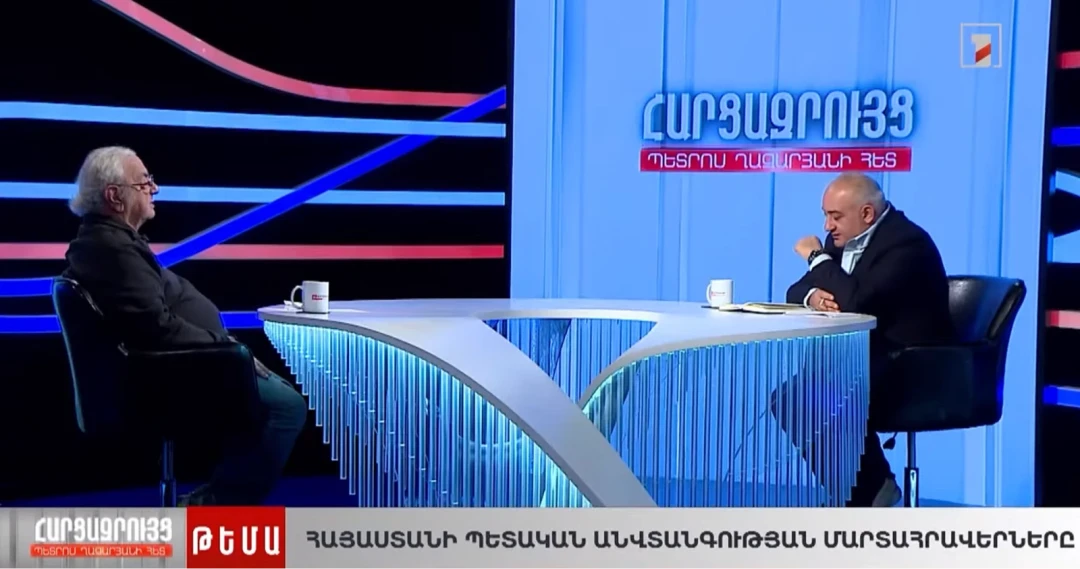
The constitutional agenda is most likely also behind the media reemergence of Gerard Libaridian, chief adviser to Armenia’s first president, Levon Ter-Petrosyan. Libaridian, who had kept a low public profile in recent years, has given three interviews over the past ten days. The most notable of these was his conversation with Petros Ghazaryan on Public Television.
One of the most noteworthy moments of the interview was Libaridian’s attempt to legitimize the demand to remove the Declaration of Independence. Referring to statements by an unnamed leader of Dashnaktsutyun and by diaspora organizations, he said that there is still a claim to Karabakh in Armenia.
This claim is misleading for two reasons. First, by citing unnamed figures, it seeks to create the impression that there are serious actors in Armenia with a realistic agenda of regaining Karabakh. The public positions on this issue of the political forces that took part in the last parliamentary elections refute this.
The most any of those forces said on the subject concerned international recognition of the right of return of Nagorno-Karabakh Armenians. In my view, this was more a tribute to the mood of the opposition electorate than a sign that the opposition has, or could have, such a realistic agenda. To conclude that statements by unnamed Dashnaktsutyun figures and the activities of diaspora organizations justify the claim that “Karabakh is a demand” is pure manipulation.
The second misleading aspect of the statement is that the Karabakh claim has nothing to do with whether the Declaration of Independence is present in the constitution. By Libaridian’s logic, will the unnamed Dashnaktsutyun leaders and diaspora organizations stop talking about Karabakh once the reference to the Declaration is removed from the constitution’s preamble? Attempts to legitimize Azerbaijan’s precondition, or even to deny its existence, with arguments of this kind leave an unserious impression, to say the least.
Nevertheless, Libaridian’s most significant claims in the interview with Petros Ghazaryan concerned Armenia’s domestic affairs. While his views on foreign policy can be debated, agreed or disagreed with, some of his statements and narratives on domestic matters are difficult to describe as anything other than anti-democratic.
Speaking about the confrontation between the government and the church, Libaridian used narratives and parallels that raise serious questions about his understanding of democratic systems. Effectively justifying the ruling party’s actions against the church over the past year, he noted that the Patriarchate of Constantinople is under the control of the Turkish state and the Patriarchate of Jerusalem under the control of the Israeli government, adding: “Throughout the entire Soviet period, the Catholicosate of All Armenians was under Moscow’s thumb for almost 70 years. That was normal, that was normal. But today it is not normal for the state to say: you cannot interfere in politics.”
The choice of countries for these comparisons is telling in itself. They are mostly states with authoritarian, and in some cases totalitarian, systems. Over the past decade, reputable international organizations that classify political regimes have regularly listed Turkey and Israel among the countries experiencing serious democratic backsliding. Yet even in these countries, governments have never made church reform or the replacement of a spiritual leader part of their election platform or government program.
The parallel with the Soviet era is even more paradoxical. Following Libaridian’s logic, one could argue that the Soviet Union exiled dissidents to the Gulag, whereas today they are merely detained, or that churches were destroyed in Soviet times, whereas today they are merely handed over to clergy who have sided with Pashinyan. This is no different from the narratives pro-government propaganda has used in recent years, justifying selective justice against various pro-Russian figures by pointing to similar practices in Russia.
During the interview, Libaridian also invoked the constitution to justify the government’s actions against the church, arguing that the church has no right to engage in politics.
From a moral and political standpoint, one may agree with Libaridian on this point. The legislation governing church–state relations, however, contains no such restriction.
Specifically, Article 17 of the Law of the Republic of Armenia “On Freedom of Conscience and Religious Organizations” states that “the participation of the church in state governance is prohibited, it does not impose any state function on the church and religious organizations.” Article 18 of the same law states that the state “reserves for members and clergy of religious organizations the right to participate in public and political life on an equal footing with other citizens.”
One could, of course, argue that this is a political rather than a legal process: the church entered the political arena, and the government chose to respond with political tools. It must be noted, however, that those tools are unconstitutional.
On Public Television, Libaridian also justified the politicized and selective justice that has recently become systemic in Armenia, stating: “Politicians became oligarchs, oligarchs became politicians, and when today the government says, ‘you are an oligarch and you stole that money,’ they say, ‘you are persecuting us as politicians because we are in the opposition.’”
This assessment completely ignores the fact that these oligarchs’ problems with the government and law enforcement began only after they became politically active. Libaridian also tactfully overlooks the fact that the ruling party’s inner circle includes people whose biographies differ little from those of the figures facing criminal prosecution, yet no one tells them, “you are an oligarch, you stole.” Here too, Libaridian most likely takes states with political systems like those of Turkey or Russia as his benchmark.
All this suggests that Libaridian’s long-standing thesis, that we must take into account the realities of our region and who our neighbors are, also shapes his understanding of democracy. The principles he advocates today are precisely those accepted in our neighboring countries: Azerbaijan, Turkey, Iran, and now, to some extent, Georgia. It turns out that finding a common language with our neighbors also implies synchronizing with their political systems.
P.S. There is one more important question concerning Libaridian’s public activity: since 2023, has Mr. Libaridian participated in bilateral negotiations with Azerbaijan as part of Armenia’s official delegations? If so, how honest is it to comment publicly on processes in which he was directly involved, without informing the wider public of this obvious conflict of interest?
The article was originally published on CivilNet.