

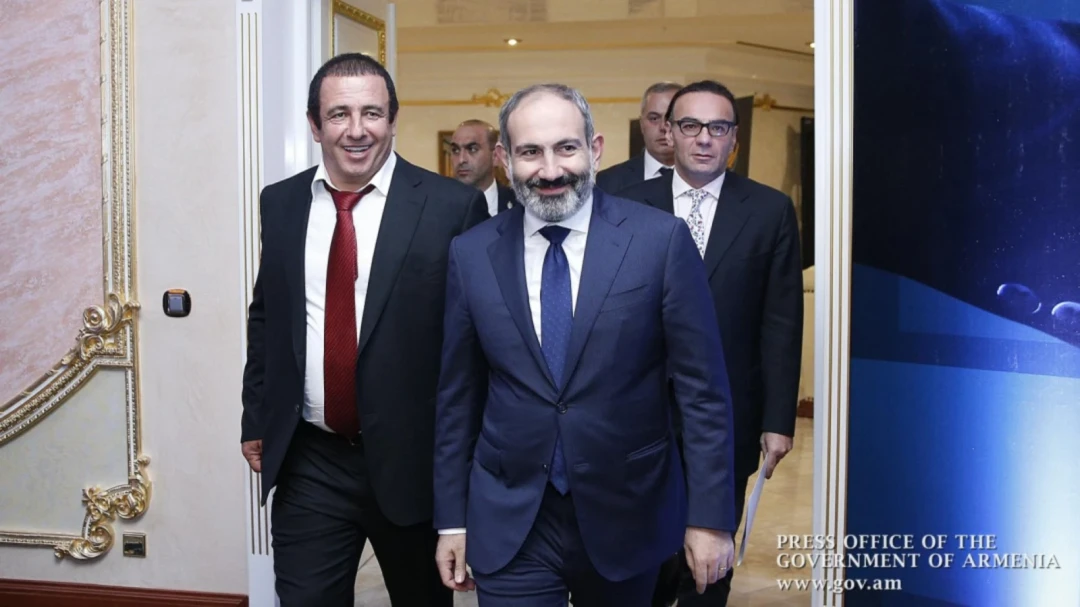
#DemocracyWatch – On July 6, the leader of the Prosperous Armenia Party, Gagik Tsarukyan, was arrested and taken to the Investigative Committee. During the day, investigative actions were also carried out at companies owned by Tsarukyan. According to the statement released by the Investigative Committee, he faces criminal charges including organizing fraud on an especially large scale, organizing money laundering on an especially large scale, and several other offenses under Armenia’s Criminal Code.
Gagik Tsarukyan’s relationship with Armenia’s authorities has repeatedly shifted over the years depending on the extent of his political engagement. In 2015, after attempting to lead the opposition movement against the constitutional amendments, he came under intense pressure from Serzh Sargsyan’s government, ultimately announcing his withdrawal from politics and resigning as leader of the Prosperous Armenia Party.
The same pattern reemerged after the 2018 Velvet Revolution. Following his harsh criticism of Prime Minister Nikol Pashinyan, calls for the latter’s resignation, and support for opposition movements, Tsarukyan became the target of several criminal cases, including charges of vote-buying during the 2017 parliamentary elections, although he was later acquitted in that case.
In short, the attention of law enforcement authorities toward Tsarukyan tends to increase as his political engagement intensifies. Whenever he adopts a more neutral political stance, he—and other major business figures—are effectively transformed from potential criminals into law-abiding businessmen.
This pattern was evident after the 2021 snap parliamentary elections, when Prosperous Armenia failed to enter parliament and Tsarukyan withdrew from active politics. His relations with the government subsequently improved. The authorities even approved several controversial projects connected to his business interests, including granting permission for the construction of the monumental statue of Jesus Christ on Mount Hatis despite significant environmental and cultural concerns raised by the public.
Tsarukyan under fire again
The current developments fit the same pattern. Against the backdrop of Tsarukyan’s renewed political engagement ahead of the June parliamentary elections, criminal proceedings have once again been initiated against him.
Leaving the legal substance of these criminal cases to legal experts, it is nevertheless important to note that this situation once again demonstrates the selective and politicized application of justice, driven primarily by the narrow political interests of those in power.
The principle of the rule of law is undermined when laws are enforced selectively. In an effective legal system, similar conduct should result in similar legal consequences, regardless of an individual’s political preferences or affiliations.
Viewed more broadly, this pattern resembles developments observed in other hybrid political systems across the post-Soviet space. During Vladimir Putin’s first presidential term in Russia, for example, the Kremlin established an unwritten pact with the country’s major oligarchs: they could retain their wealth and privileged access to state resources as long as they refrained from engaging in politics. The well-known criminal prosecution of Mikhail Khodorkovsky became the clearest example of the consequences of violating this unwritten agreement.
Debates surrounding the Khodorkovsky case were never limited to the question of his personal guilt or innocence. Few disputed that many Russian oligarchs had benefited from legally questionable privatization processes in the 1990s and were likely involved in other unlawful activities. The central criticism was that only the politically disloyal oligarch was prosecuted, while others with nearly identical backgrounds—but who remained politically loyal—faced no legal consequences.
There are already serious indications that Armenia is moving down a similar path, where legal institutions are gradually becoming instruments for managing political competition rather than ensuring impartial justice.
Recent developments reinforce these concerns. Immediately after the parliamentary elections, criminal proceedings were also initiated against several opposition politicians. Although the details of these investigations remain unclear, their timing coincides with Prime Minister Pashinyan’s post-election rhetoric directed against what he described as the “three-headed party of war.”
Of course, chronology alone does not prove political motivation. However, when criminal prosecutions consistently coincide with shifts in the political positioning of different actors, they inevitably raise legitimate questions about the independence and autonomy of law enforcement agencies and the judiciary.
More broadly, these developments suggest that Armenia continues to drift away from the promises and aspirations of the 2018 Velvet Revolution. Rather than implementing institutional reforms and strengthening democratic accountability, recent trends increasingly resemble the post-Soviet model of governance, characterized by the use of administrative resources and politicized, selective justice.
The situation surrounding Tsarukyan also highlights another major structural challenge facing Armenia’s political system. When the opposition space becomes monopolized by oligarchic forces, it creates vulnerabilities that can be exploited by the ruling party. This remains an important factor even in the case of the opposition parties represented in parliament. At the same time, such a situation allows the authorities to shift all forms of criticism into the realm of polarized political discourse, where their own shortcomings and unlawful actions are justified or neutralized by pointing to the character and past record of the existing opposition.
Democracy Watch is a joint initiative of CivilNet and the Regional Center for Democracy and Security.