

by Eduard Arakelyan
Last week, Azerbaijan showcased several key developments in the evolution of its armed forces. The country conducted training flights of its new JF-17 Block III fighter jets, launched large-scale ground forces exercises, and had its special operations forces participate in joint survival training with Serbian troops. Taken together, these activities reflect Baku’s comprehensive approach to enhancing military readiness by combining rearmament, intensive combat training, and the expansion of international military cooperation.
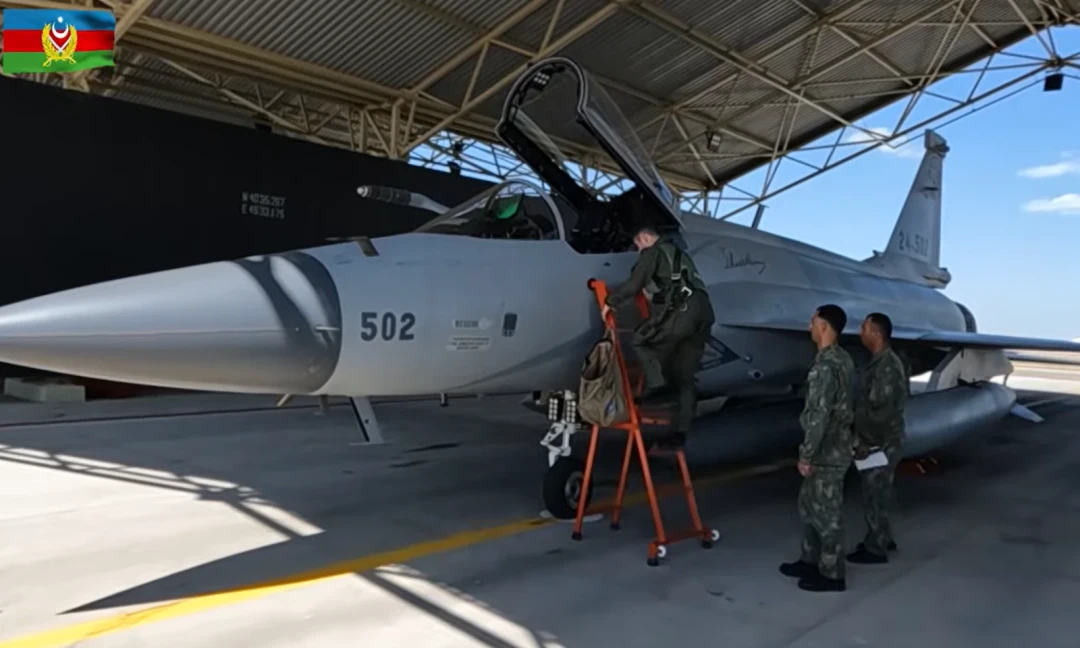
The official demonstration of the JF-17 Block III indicates the beginning of the aircraft’s full operational service within the Azerbaijani Air Force. Available evidence suggests that the flights were conducted from Nasosnaya Air Base. In recent years, the base has undergone extensive infrastructure upgrades, including the construction of hardened aircraft shelters, indicating preparations for permanently stationing the new fighter fleet while improving the survivability of Azerbaijan’s air assets.
The released footage shows two JF-17 fighters bearing tail numbers 24-501 and 24-502. The nose sections of at least two additional aircraft of the same type were visible inside hardened shelters, suggesting that more fighters are already stationed at the base than have been officially presented.
The JF-17 Block III is the most advanced variant of the platform. The approximately $4.6 billion contract for 40 aircraft represents the largest defense export deal in Pakistan’s history.
Despite earlier plans to transition to the Chinese WS-13 engine, available information indicates that Azerbaijan’s JF-17s continue to be powered by Russian RD-93 engines. This means that, despite the aircraft’s Chinese-Pakistani origin, the program remains dependent on Russian components.
Azerbaijan’s selection of the JF-17 reflects a broader shift in its combat aircraft procurement strategy. Beyond tactical and technical performance, key considerations included availability, relatively low operating costs, and the supplier’s ability to fulfill the contract on schedule.
An equally important element of Azerbaijan’s military posture remains maintaining the combat readiness of its ground forces through regular operational and combined-arms exercises.
On July 8, Azerbaijan’s Ministry of Defense announced the launch of large-scale ground forces exercises.
The Azerbaijani Armed Forces demonstrated the full cycle of operational deployment: moving equipment from permanent bases, transporting forces by rail and heavy transporters, deploying to designated operational areas, and transitioning to the active phase of the exercise, including live-fire drills.
The exercises involved T-72 and T-90 tanks, infantry fighting vehicles, BTR-82A armored personnel carriers, towed artillery, and multiple launch rocket systems. Particular emphasis was placed on assault operations, offensive tactics, breaching trench systems, clearing urban terrain, and sustaining continuous combat operations during both day and night.
This format demonstrates that Azerbaijan continues to prioritize preparation for high-intensity combined-arms warfare involving large mechanized formations. Such exercises simultaneously test command and control systems, inter-service coordination, logistics, strategic mobility, and the ability of military leadership to coordinate large-scale operations.
Alongside strengthening its domestic military capabilities, Azerbaijan continues to expand practical defense cooperation with foreign partners.
Special Operations Forces from Azerbaijan and personnel of the 63rd Parachute Brigade of the Serbian Armed Forces conducted joint survival and autonomous field operations training. The program included covert movement, construction of temporary shelters, food procurement, water collection and purification, and battlefield first aid. Serbia’s Chief of the General Staff attended the exercise and praised the level of cooperation between the participating units.
Although relatively limited in scale, these activities reflect the steady development of bilateral military cooperation and growing interaction between the elite units of the two countries. In May 2025, Azerbaijani special forces had already trained Serbian troops at Azerbaijani training grounds using Turkish military methodologies combined with their own operational experience.
The expansion of military cooperation with Serbia demonstrates Azerbaijan’s intention to diversify its international defense partnerships not only through its strategic alliances with Turkey and Pakistan but also by strengthening military ties with European countries.
During the first half of 2026, Azerbaijan and Turkey conducted a series of major joint military exercises. To date, the two countries have held at least six large-scale activities, including multinational formats. These included the computer-assisted winter exercise “Indestructible Brotherhood-2026,” the tactical air exercise “TurAz Eagle-2026,” the battalion tactical group exercise “Heydar Aliyev-2026,” as well as the multinational exercises “EFES-2026,” the air exercise “Anatolian Eagle-2026,” and the special forces exercise “Caucasian Eagle-2026.”
Several additional major exercises between Baku and Ankara are likely to take place during the second half of the year.
Against this backdrop, the approach to military training in Armenia differs noticeably. Despite the ongoing reform of the Armenian Armed Forces and expanding defense cooperation with France, India, the United States, Greece, and several other partners, Yerevan remains primarily focused on training individual units, conducting staff exercises, and holding tactical-level drills. Large-scale combined-arms exercises involving multiple service branches, major mechanized formations, and operational troop movements are conducted only rarely, limiting opportunities to comprehensively test command-and-control systems and joint force integration.
Armenia currently concentrates primarily on structural reforms, arms procurement, and improving the readiness of individual units. However, without regularly testing the entire command structure and inter-service coordination through large-scale operational exercises, the full potential of these reforms will inevitably remain only partially realized.
Operational and operational-tactical exercises allow armed forces to test their ability to function as a unified system—from intelligence collection and command and control to logistics and engineering support. The absence of regular army-wide maneuvers therefore remains one of the most significant limitations affecting the reform of Armenia’s Armed Forces.
It cannot be ruled out that the political context is one of the factors shaping Armenia’s training posture. The country’s leadership has consistently sought to avoid actions that neighboring states might interpret as preparations for military escalation. Within this logic, conducting large-scale combined-arms exercises may also be viewed as a political liability capable of provoking an undesirable reaction from Azerbaijan and Turkey.
The article was originally published on CivilNet.