

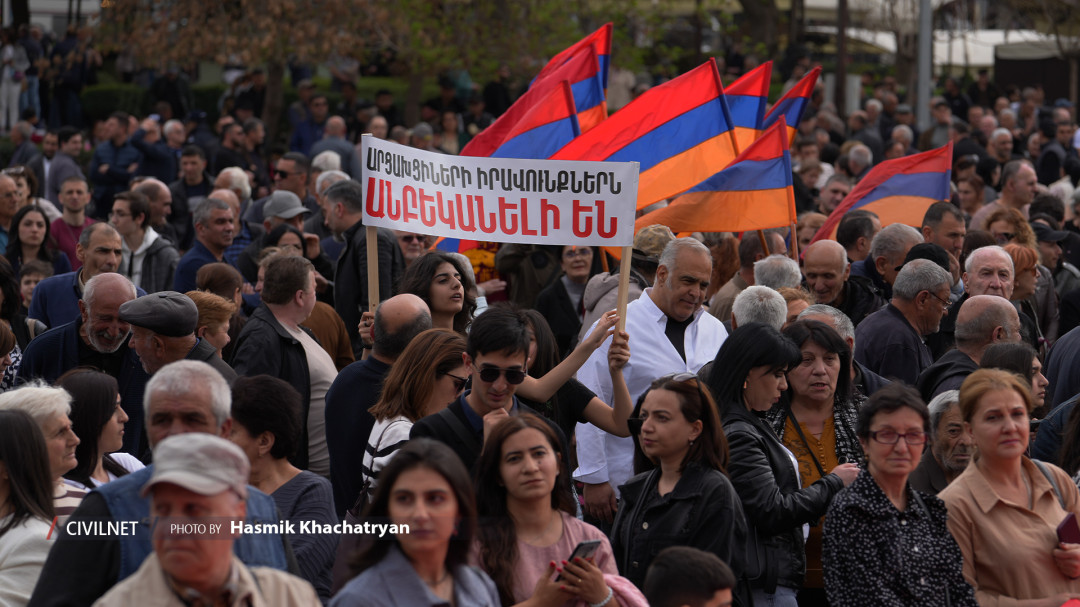
On September 23, the Human Rights Protection Committee of the National Assembly of the Republic of Armenia had organized a discussion about the socio-economic and legal issues Nagorno-Karabakh Armenians face. It seemed that this should have been one of the rare platforms where it was possible to speak, without excessive politicization, about the problems tens of thousands of people living in Armenia are facing.
However, the discussion did not go smoothly. Representatives of the Government of the Republic of Armenia and of the National Assembly’s “Civil Contract” faction left the hall after Lilit Galstyan, the committee chair presiding over the session, announced that representatives of the Nagorno-Karabakh National Assembly factions were also present at the discussion.
This reaction was not accidental. For the authorities of Armenia, even a formal mention of the state bodies of the Republic of Nagorno-Karabakh has become politically unacceptable. Moreover, in the authorities’ discourse it’s difficult to avoid the impression that they take issue not only with the state institutions of Nagorno-Karabakh, but with the very word “Nagorno-Karabakh”.
One can discuss at length to what extent this behavior is conditioned by either Azerbaijan’s potential backlash or the Armenian authorities’ own political calculations. Yet one thing is obvious: on the part of the authorities there is a policy of caution toward the topic of Nagorno-Karabakh, and in some cases, of obvious fear. Gradually, this policy is going beyond the framework of mere foreign policy, affecting the authorities’ narratives about the Karabakh movement, the history of Nagorno-Karabakh, and even the Republic of Armenia’s most recent history.
It goes without saying that the protection of Nagorno-Karabakh Armenian’s rights is not a single issue on a single front.
The issues of working with Armenia’s government, the social and economic integration of Nagorno-Karabakh refugees in Armenia, the restoration of their rights violated by Azerbaijan, combatting hate speech, international legal processes, and the political representation of Nagorno-Karabakh cannot all be resolved with the same tools.
Including all of these issues in one broad political package may even harm each of them individually.
Regarding socio-economic problems, the most important and influential partner is the Government of Armenia. Housing provision, employment, social programs, education, healthcare, and many documentation-related and legal problems are resolved in Armenia and, ultimately, through Armenia’s state system. Therefore, what is needed in this regard is not constant public confrontation, but consistent and pragmatic work. It is necessary to find those links and people through whom it is possible to bring proposals to the government, present specific problems, and achieve specific solutions. In many cases this work should not take place in public. There are many problems, large and small, whose resolution will be much easier if they are not turned into yet another point of contention in the political arena.
It is especially important to keep the social and economic problems of Nagorno-Karabakh refugees as far as possible from Armenia’s polarized political environment. Housing, work, social support, or everyday legal problems of Nagorno-Karabakh Armenians should not become yet another pawn between the authorities and the opposition.
Combatting hate speech toward Nagorno-Karabakh refugees requires a different tactic. Discrimination and hate speech against Nagorno-Karabakh Armenians by representatives of the Armenian government or by public figures close to the authorities should be counteracted adequately. The leaders of the ruling party need to work toward restraining anti-Nagorno-Karabakh rhetoric and eradicating hate speech against Nagorno-Karabakh Armenians by high-ranking officials. Proper effort needs to be put into countering hate speech directed at Nagorno-Karabakh refugees on social networks, in the media, and on other public platforms, including by involving law enforcement bodies, taking cases to court, and, in case domestic procedures are exhausted, to the European Court of Human Rights.
The advocacy against Azerbaijan’s violations of the collective and individual rights of Nagorno-Karabakh Armenians should also follow a separate logic. Here, it is necessary to involve human rights organizations from Armenia, Diaspora structures, international lawyers, as well as representations of the Republic of Nagorno-Karabakh operating in various countries and those bodies that have relevant international connections and experience.
The collective rights, property rights, the preservation of cultural heritage, personal and family rights, the issues of people still held in captivity, and other problems require long-term, systematic work. On this front it is necessary not only to make political statements, but also to create as many documents as possible: legal applications, court decisions, parliamentary resolutions, reports of international bodies, and other documents. Every single one of these documents may later become part of a larger legal or political process.
For the protection of Nagorno-Karabakh Armenians’ rights, it is necessary to abandon the approach stating that all problems must be resolved on a single political front and by the same methods.
Work with the authorities of Armenia requires one type of toolkit: negotiation, proposals, professional work, and consistent contacts.
Combatting hate speech, however, requires a different toolkit: documentation, legal processes, public oversight, and the use of international legal mechanisms.
The struggle against Azerbaijan, ultimately, requires a third kind of work, more long-term and international in character: legal, diplomatic, parliamentary.
This division is a necessity not in order to fragment the Nagorno-Karabakh agenda, but rather to make it more effective.
The discussion of the National Assembly committee on September 23 showed that the topic of Nagorno-Karabakh continues to remain a politically sensitive and complex issue in Armenia. But that complexity should not force us to abandon the work of resolving the problems Nagorno-Karabakh refugees face. On the contrary, it is necessary to be more precise in our tools of choice.
At the same time, the attitude of the authorities of Armenia toward Nagorno-Karabakh state institutions should not be allowed to turn into a reason for abandoning the agenda of the rights of Nagorno-Karabakh refugees.
There may be different positions on Nagorno-Karabakh’s state status, history, or political assessments. But the social, economic, civil, and international legal rights of Nagorno-Karabakh refugees do not disappear as a result. Consequently, what is needed today is not so much to speak out about everything at the same time, as to correctly understand where each issue is resolved, who its addressee is, and by what measures results can be achieved.
The protection of the rights of Nagorno-Karabakh Armenians is a long-term issue. In order to succeed, not only steadfastness are needed but also composure, specialization as well as wisely chosen tactics.
Hayk Khanumyan