

By Tigran Grigoryan and Hayk Khanumyan
On May 8, 2026, the official campaign period for the elections to the National Assembly of the Republic of Armenia commenced. The month of May was marked by unprecedented levels of hate speech, with the primary generators being representatives of the ruling Civil Contract Party and their supporters. Once again, the central figure responsible for hate speech targeting Armenians from Nagorno-Karabakh was Prime Minister Nikol Pashinyan.
The most notable incidents occurred on May 18, when the ruling party was conducting campaign activities in Yerevan’s Arabkir district. From early morning, Nikol Pashinyan was showing people a video of suspicious origin that had received limited circulation at the time. In the footage, masked individuals, apparently holding assault rifles, accuse Prime Minister Pashinyan of surrendering Nagorno-Karabakh while speaking in the Nagorno-Karabakh dialect and threaten him, stating that they are monitoring him and know the route taken by his motorcade.
Nikol Pashinyan began commenting on the video in an agitated manner, identifying the masked individuals with opposition leaders. He repeatedly emphasized their “Karabakh accent.” Although his statements were ostensibly directed at the unidentified masked individuals, Pashinyan used language and framing that generalized the accusation, reinforcing a narrative he had previously promoted about “runaway Karabakh Armenians.”
Moreover, he introduced new elements into this narrative that are frequently encountered in hate speech-laden comments under various social media posts. Pashinyan called on the masked individuals to remove their masks so that everyone could see that they were “cowards who fled from Karabakh in Ferraris, abandoned the battlefield, and perhaps even shot our children in the back.”
“You will each be held accountable for leaving our children alone in the trenches and running away,” Pashinyan threatened the unidentified individuals in the video, who spoke in the Karabakh dialect.
Rather than addressing the specific individuals appearing in the video, Pashinyan generalized them to all Armenians from Nagorno-Karabakh and all those speaking with a “Karabakh accent,” attributing fabricated grave crimes to this group, including “shooting our children in the back” and “leaving our children alone in the trenches and fleeing.” Such rhetoric generates deep, instinctive hostility toward the targeted group.
The danger of hate speech in this case lies in the transformation of criticism directed at unidentified individuals into collective accusations targeting forcibly displaced Armenians from Nagorno-Karabakh and their dialect.
Pashinyan further advanced this narrative during the incident involving physician Arpine Soghoyan. The woman approached the Prime Minister while he was conducting a campaign event near her apartment building, stating that her brother, a high-ranking officer, had gone missing during the 2020 war and accusing Pashinyan of “destroying the country.”
The criticism angered Pashinyan, who began equating the physician with opposition leaders, shouting at her. When the woman attempted to leave, he grabbed her by the hand and pulled her back toward him, forcing her to listen to him until the end.
“You tried to make us kneel,” the Prime Minister said, but he himself would “make Robert, Serzh, the Kalugan, and Gago kneel and destroy them,” referring to former presidents Robert Kocharyan and Serzh Sargsyan, Prosperous Armenia Party leader Gagik Tsarukyan, and Strong Armenia Party leader Samvel Karapetyan.
Although the woman was not a forcibly displaced person from Nagorno-Karabakh, but rather a resident of the Yerevan neighborhood for several decades, the Prime Minister once again invoked Nagorno-Karabakh in his response:
“You destroyed it, you destroyed it. You plundered through Karabakh.”
By responding to any criticism with accusations connected to Nagorno-Karabakh, Nikol Pashinyan targets forcibly displaced Armenians from Nagorno-Karabakh even in cases where the issues under discussion have no connection to them.
“Why Are You Alive?”: Stigmatization and Collective Blame
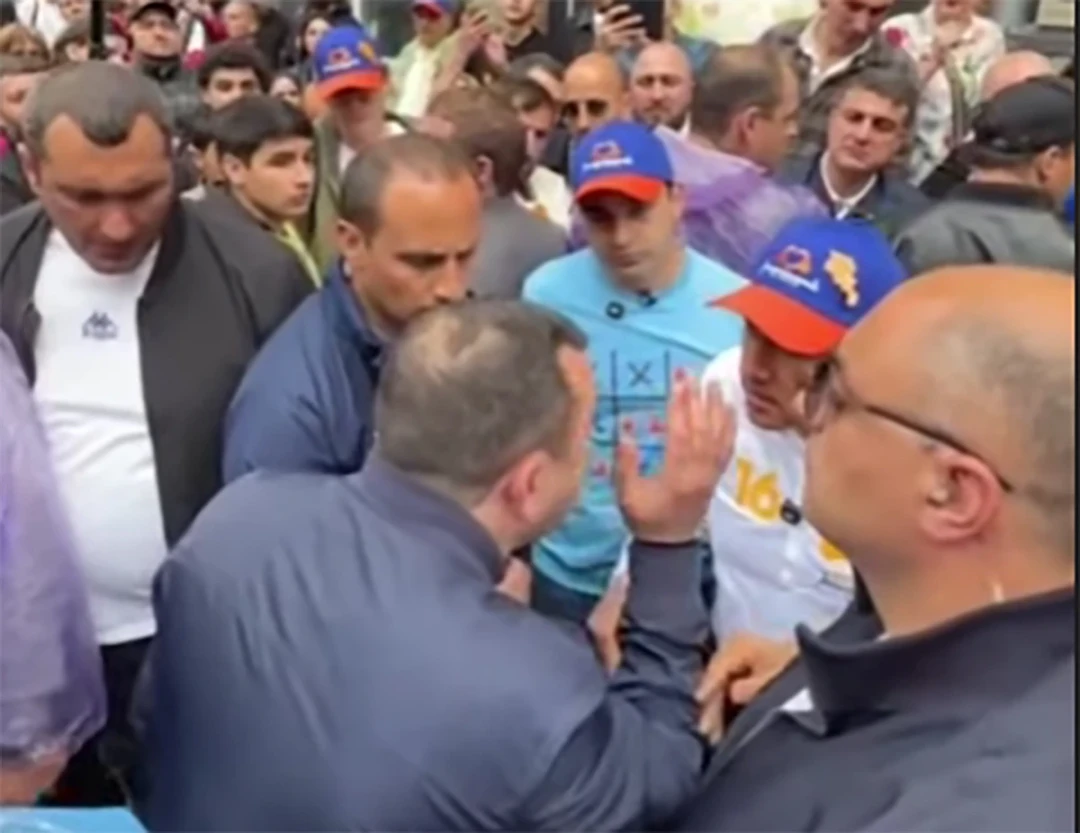
However, the culmination of May 18 was the incident involving Nagorno-Karabakh political activist Arthur Osipyan, during which the Prime Minister again resorted to rhetoric inciting hostility toward Armenians from Nagorno-Karabakh.
During Pashinyan’s campaign event, Osipyan approached him and accused him of protecting and patronizing corrupt officials in Nagorno-Karabakh. This provoked an angry reaction from Pashinyan:
“These pseudo-elites from Karabakh have come here waving their fingers at us. Get lost. Who are you, anyway? ‘I am Arthur Osipyan.’ You hit your head against the wall; you should have gone and died instead of our children. ‘I am Arthur Osipyan.’ You thieving animals. Why are you alive? Why are you alive, when you are the one talking about 5,000 victims? You bastard, why are you alive?”
In this case, we are dealing with the phenomenon of stigmatization. In international legal and expert definitions of hate speech, stigmatization is considered one of the key mechanisms and dangerous consequences of hate speech. International organizations define stigmatization as a process through which a particular group or individual, based on national, regional, religious, or other characteristics, is labeled in the public sphere with negative, degrading, or “traitorous” attributes, making them marginalized and more vulnerable to violence.
Through the rhetoric “you should have died instead of our children; why are you alive,” Pashinyan attempts to introduce the idea into public discourse that any Armenian from Nagorno-Karabakh who survived the war and dares to raise political demands is a “traitor” or a “deserter” because they did not die.
It is noteworthy that Pashinyan continued repeating these narratives in the days following the incident. During a May 28 briefing with journalists, the Prime Minister stated:
“Where did Arthur Osipyan fight, that he has come forward to raise the Nagorno-Karabakh issue?”
Arthur Osipyan is a participant of the 2020 war, a fact also confirmed by his fellow servicemen.
The statements made by Armenia’s Prime Minister during this incident and in the following days are part of broader propaganda narratives promoted by the ruling party in recent years targeting forcibly displaced persons from Nagorno-Karabakh. These narratives seek to portray Armenians from Nagorno-Karabakh as deserters and shift responsibility for ethnic cleansing onto the victims themselves.
In this context, Nikol Pashinyan’s accusation — “why are you alive?” — represents a logical continuation of the controversial statement made nearly a year earlier by National Assembly Speaker Alen Simonyan: “You did not fight; you should have stayed and fought.”
During the incident involving Arthur Osipyan, Pashinyan effectively voiced the implicit message contained in Simonyan’s statement.
This discourse, as well as similar narratives used by government and pro-government figures regarding forcibly displaced Armenians from Nagorno-Karabakh, also clearly employs a polarizing “us versus them” framework. When Pashinyan states that Osipyan should have died “instead of our children,” he effectively creates dividing lines among participants of the war, categorizing them into different groups.
Immediately after the confrontation with Nikol Pashinyan, Arthur Osipyan was detained for two months. He was charged under three articles: hooliganism, obstructing election campaigning, and publicly calling for violence. Osipyan declared a hunger strike, demanding that Nikol Pashinyan apologize to him.
Only after pressure from civil society, on June 10 — the 24th day of his hunger strike — was Osipyan’s detention lifted. The political activist ended his hunger strike and stated that he would seek to compel Nikol Pashinyan to apologize through legal proceedings.
The Amplification of Collective Blame by Pro-Government Influencers
The incident involving Arthur Osipyan also became a catalyst for various pro-government bloggers and social media users, who have repeatedly generated hate speech targeting forcibly displaced Armenians from Nagorno-Karabakh, to once again direct attacks against this community.
For example, pro-government blogger Roman Baghdasaryan published the following post on Facebook:
“When you are from Karabakh… when there is nothing between your legs except a pad… when you run away, abandoning 18-year-old soldiers from Armenia in the trenches… when you do not care about the contract you signed in the army… when you can hold a steering wheel for eight hours but cannot hold a rifle, and when you do not defend your churches. Tens of thousands of Karabakh men who soiled their pants out of fear when they saw the troops of a neighboring country… are now complaining that churches are being desecrated. But who stopped you from protecting those churches instead of fleeing? And these traitors on their own land criticize Pashinyan,” the widely followed Facebook user concluded his post.
Roman Baghdasaryan, who has repeatedly generated hate speech against Armenians from Nagorno-Karabakh, enjoys visible support and patronage from Armenian law enforcement agencies (see the April report). Such extreme hate speech targeting forcibly displaced Armenians from Nagorno-Karabakh seeks to dehumanize a specific community and portray its members as “deserters,” thereby legitimizing potential violence against them through the narrative that “deserter Karabakh Armenians abandoned 18-year-old soldiers and are responsible for the deaths of our children.”
By collectively labeling Armenians from Nagorno-Karabakh as deserters, Roman Baghdasaryan reinforces the propaganda stereotype that soldiers who came from Armenia to fight in Nagorno-Karabakh fought, while Armenians from Nagorno-Karabakh fled. This contributes to the creation of deep hostility between different segments of society.
Ultimately, the conclusion of Baghdasaryan’s post is that no Armenian from Nagorno-Karabakh has the right to criticize the authorities. First, Armenians from Nagorno-Karabakh are dehumanized; then they are deprived of their right to participate in public discourse.
Baghdasaryan was not the only pro-government user who spread hate speech targeting forcibly displaced Armenians from Nagorno-Karabakh following the Osipyan incident. Tatul Asilyan, a supporter of the ruling party who actively participated in Civil Contract’s election campaign and has previously been known for hate speech targeting Armenians from Nagorno-Karabakh, called for their expulsion from Armenia:
“The tongues of those Karabakh Armenians whose tongues are too long should be cut off from the root. Dear Prime Minister, expel them from our country.”
This user was also discussed in our April report.
The Osipyan incident also provided an opportunity for another pro-government user, Anita Harutyunyan, to target Armenians from Nagorno-Karabakh, insult them, and advance another narrative promoted by Armenian authorities — that of the “ungrateful Karabakh Armenians.”
An examination of this user’s Facebook page shows that she actively participated in the election campaign of the ruling Civil Contract Party and distributed campaign materials to citizens alongside influential party members while wearing Civil Contract-branded clothing.
During her May 18 Facebook livestream, the pro-government user attacked Arthur Osipyan for criticizing the Prime Minister and then generalized her accusations toward all Armenians from Nagorno-Karabakh:
“…Didn’t we do anything for you, you scum? Didn’t we do anything for you? Didn’t we help you? Didn’t we give you homes? Didn’t we help you with medicine? Didn’t we save you? Didn’t we go to war for you? Didn’t we spend our last penny for you? Didn’t we bring the food from our homes for you? Didn’t you wear our clothes? Didn’t we do anything for you, you animal? The fifty thousand [drams] you receive — is that nothing?”
Developing further the Prime Minister’s “why are you alive?” narrative, Harutyunyan continued:
“Yes, why are you alive? Why are you even alive? Why do you live? You should have gone and died with the boys. At least then we would know that you were useful for something; we would say that he died in an immortal way. He did not die — he perished… Why did someone like you have to be born? What kind of way is this to speak to the Prime Minister? What kind of way is this to express yourself in general? What kind of way is this to disrespect a person? I have never seen people like you. Day by day, hour by hour, second by second, I become more convinced that there is no one as despicable as Karabakh Armenians. There are a few good people, but because of people like you, we do not even want to see them anymore.
Yes, why should we help you? Why should our boys have shed blood for you? Why should we have gone and defended Karabakh, so that people like you, these scum, would come out and say: ‘What have you done for us?’ Why should we have done that? Why? Why should we today not even be able to look into the eyes of the parents because of the 44-day war? You worthless creature…”
Thus, Harutyunyan not only repeats but further radicalizes the narrative promoted by the Prime Minister, transforming a political dispute with one individual into a collective accusation against all Armenians from Nagorno-Karabakh. Her statements contain clear elements of dehumanization, collective blame, and the portrayal of an entire group as undeserving of solidarity or support.
State Assistance as a Tool of Political Loyalty and Pressure
However, insinuations that politically disloyal Karabakh Armenians should leave the country were not limited to pro-government social media users. In May, during the election campaign period, a similar incident was recorded in one of the settlements of Talin, when Talin community mayor Tavros Sapeyan entered the property of a forcibly displaced Armenian from Nagorno-Karabakh and attempted to hand her campaign materials of the ruling Civil Contract Party.
The woman stated that she did not engage in politics, respected the mayor, but was not interested in political parties. In response, the mayor accused her of being ungrateful.
The exchange unfolded as follows:
Mayor: “This house where you live — whose is it?”
Woman: “It is mine at this moment.”
Mayor: “Who provided the money for it?”
Woman: “The money was provided by the state — the state, not some individuals from their own pockets.”
Mayor: “Look, we are the ones standing at the head of the state — Nikol Pashinyan. And who helped your children on the first day?”
Woman: “I have been grateful to the people who helped us. What anyone is implying is not our concern. We are not interested in politics.”
Mayor: “With this attitude, you will not live long in the Republic of Armenia… You will come and apply, and I will buy you a ticket to Russia.”
Woman: “Why? Is this also considered belonging to the enemy? No. I would rather die with dignity than live humiliated.”
Mayor: “If you were going to die, you should have died in your Karabakh.”
The psychological pressure, intimidation, and hate speech directed by the community mayor toward a forcibly displaced person reveal several interconnected layers.
First, there is the political monetization of state assistance programs and the imposition of a sense of indebtedness by labeling the recipient as “ungrateful.” Assistance programs provided by the state to forcibly displaced Armenians from Nagorno-Karabakh constitute a state obligation, not charity or personal benevolence. The mayor attempts to portray public support provided through state resources as a political favor granted by a party, seeking in return political loyalty and/or votes.
When the woman rejects this implied exchange, she is labeled as ungrateful.
In his statements, Sapeyan also erases the distinction between the state and his political force. By claiming that “we — Nikol Pashinyan — stand at the head of the state,” the mayor suggests that opposition to their political group constitutes opposition to the state itself.
The mayor then moves to explicit intimidation, stating: “With this attitude, you will not live long in the Republic of Armenia.” Addressing a woman who had already been displaced from her home once, he implies that she is a guest rather than a full member of Armenian society and that failure to demonstrate political loyalty should result in her leaving the country.
This episode deepens the sense of insecurity and alienation among displaced Armenians from Nagorno-Karabakh.
Conclusion
Summarizing our monitoring observations regarding the spread of hate speech targeting Armenians from Nagorno-Karabakh during May, we can conclude that the primary actors fueling hostility against this group were representatives of the ruling party, led by Prime Minister Nikol Pashinyan.
Moreover, Nikol Pashinyan has systematically developed and promoted various narratives targeting Armenians from Nagorno-Karabakh, many of which have subsequently spread widely in public discourse and on social media.
Open hate speech targeting Armenians from Nagorno-Karabakh has also been disseminated by pro-government users, including calls for their expulsion from Armenia.
Law enforcement bodies continue to demonstrate inaction in response to these incidents.
This report was produced with the financial support of the European Union and the German Marshall Fund of the United States – Transatlantic Foundation (GMF TF). Its contents are the sole responsibility of the Regional Center for Democracy and Security and do not necessarily reflect the views of the European Union or the GMF TF.