

By Lili Dubois-Harounyan
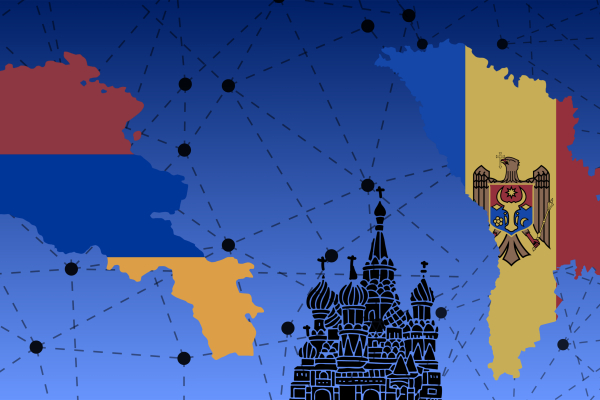
The comparison between Armenia and Moldova in the face of foreign information manipulation and interference (FIMI) threats is gaining increasing prominence in European discourse. At a recent conference on countering information interference, EU High Representative Kaja Kallas explicitly drew a parallel between the two countries, noting that after what was widely perceived as an unsuccessful attempt to influence Moldova’s electoral environment, Russia appeared to have deployed similar operational methods in Armenia, this time in a more anticipatory and structured manner.
This comparison reflects a broader tendency among international actors to analyse Armenia and Moldova through shared analytical frameworks, highlighting common dynamics in Russian influence strategies across what Moscow still perceives as its “near abroad.” In both cases, Russian information manipulation campaigns follow a strategic logic aimed at preserving or restoring Moscow’s political leverage through influence mechanisms designed to shape domestic perceptions and exploit structural vulnerabilities.
Yet while this comparison highlights real dynamics in the diffusion of Russian informational practices, it risks oversimplifying two fundamentally distinct contexts. Although Armenia and Moldova share a Soviet legacy, they differ significantly in their political, economic, and geopolitical trajectories, which shape the modalities and effects of Russian information operations.
The comparison is therefore useful, but only if it remains attentive to the structural differences that condition how information influence is produced, disseminated, and received.
This article offers a synthesis of a more detailed report available on the website of the Regional Center for Democracy and Security.
Shared Structural Vulnerabilities
Despite distinct trajectories, Armenia and Moldova share structural vulnerabilities that create openings for Russian information influence.
Both countries are moving closer to the European Union, albeit through different modalities. Moldova’s candidate status provides a formalised accession framework. Armenia’s relationship with Brussels remains less institutionalised, structured primarily through the Comprehensive and Enhanced Partnership Agreement (CEPA), but has deepened significantly in recent years through enhanced political dialogue and strengthened strategic cooperation.
This rapprochement reflects efforts to diversify strategic partnerships and reduce exposure to Russian pressure. In this context, Russia deploys a broad range of hybrid tools, from economic coercion and cyberattacks to information operations, to slow or counter this process.
Both states remain exposed to forms of structural dependence that underpin influence operations. Moldova’s past reliance on Russian energy has long been a key vulnerability, even as it has declined since 2022 through integration with European markets. Armenia remains heavily dependent on Russian gas and maintains significant economic interdependence with Moscow.
These dependencies provide material foundations for narrative construction. Russian-aligned messaging frequently frames European integration as economically costly, warning of energy price increases, trade losses, and instability while attributing these risks to Western pressure.
Unresolved territorial conflicts further reinforce these vulnerabilities. In Moldova, Transnistria and Gagauzia are often instrumentalised to spread narratives of “imminent war” linked to EU integration. In Armenia, the 2023 loss of Nagorno-Karabakh and the displacement of over 100,000 people remain a central political trauma, frequently used to question government legitimacy and the country’s geopolitical reorientation.
Convergent Narrative Architectures
Russian influence campaigns in both contexts rely on standardised but locally adapted narrative frameworks.
Common themes include corruption allegations, moral decay, sovereignty erosion, and claims of Western external control.
In Moldova, President Maia Sandu is often portrayed as acting on behalf of Brussels. In Armenia, Prime Minister Nikol Pashinyan is similarly depicted as detached from national interests and aligned with Western agendas.
Fears of identity loss also converge. In Moldova, narratives of Romanian absorption and state dissolution are widespread. In Armenia, the narrative about Turkish and Azerbaijani influence is frequently instrumentalized to target the ruling party.
These narratives circulate through similar digital ecosystems, including Telegram channels, coordinated amplification networks, and increasingly AI-assisted content production, enabling rapid cross-border diffusion.
Religious and moral framing also plays a role. In Moldova, Orthodox networks and affiliated communities often disseminate conservative and anti-European messaging. In Armenia the Armenian Apostolic Church is not subordinated to the Russian Orthodox Church and cannot be understood as inherently aligned with Russian interests. Rather than reflecting direct ecclesiastical influence, the Armenian case is characterised by the instrumentalisation of the Church–state controversy itself.
Across both cases, elections are framed not only as political choices but as civilisational decisions concerning identity, sovereignty, and geopolitical alignment.
Armenia’s Distinct Information Environment
Despite similarities, Armenia’s information environment is more fragmented and competitive.
Unlike Moldova, where Russian influence is dominant, Armenia faces overlapping Russian, Azerbaijani, and Turkish narratives. These do not always reflect coordination but often converge in framing Western engagement as destabilising and externally imposed.
Transnational actors further complicate this space. Media figures operating across Russian- and Turkish-speaking networks act as amplifiers, blurring the boundaries between journalism, political messaging, and influence operations.
This creates a more opaque and harder-to-regulate information ecosystem.
The Role of the Diaspora
The role of the diaspora constitutes a key point of divergence between both cases, reflecting fundamentally different configurations of external political influence.
In Moldova, it is large, highly mobilised, and strongly pro-European. The Moldovan diaspora played a decisive role in the last election, with around 82–83% of voters abroad supporting Maia Sandu, which proved crucial for her re-election.
In Armenia, the diaspora is larger and more fragmented, but politically less directly influential due to electoral rules, as only Armenian citizens registered in the national population register are entitled to vote in national elections.
Diverging Resilience Capacities
Institutional resilience represents a key divergence.
Moldova has gradually developed mechanisms to counter FIMI, accelerated by the war in Ukraine and the 2024 electoral cycle. Coordination between state institutions, civil society, media, and EU partners has improved detection and response capacities.
Armenia’s institutional response is more recent. Since 2020, and especially after 2023, authorities have begun developing frameworks for countering disinformation. However, these remain partial and heavily reliant on civil society.
As a result, FIMI campaigns have different effects: in Moldova, they operate in a more sensitised environment; in Armenia, they can more easily amplify existing anxieties related to security and geopolitical uncertainty.
Why the Comparison Matters
The comparison between Armenia and Moldova is both useful and limited.
It is useful because it reveals recurring patterns in Russian influence strategies, including similar tools, narratives, and adaptive logics.
It is limited because it risks obscuring fundamental contextual differences.
Moldova’s information space is shaped primarily by political polarisation around EU integration. Armenia’s is shaped by post-war trauma, security insecurity, and a more complex regional information battlefield.
While Moldova offers lessons in institutional resilience, these cannot be directly transposed onto Armenia. Moreover, Russian information practices in Armenia appear increasingly adaptive, suggesting learning from earlier contexts such as Moldova.
Effective responses must therefore account for Armenia’s specific constraints, including its security dependence and the multiplicity of foreign actors operating in its information space.
The value of comparison lies not in equivalence, but in identifying broader patterns while preserving analytical precision.
As Armenia approaches future electoral cycles, this balance between comparative insight and contextual specificity will remain essential for understanding evolving dynamics of information influence in the region.