
Democracy Watch

Publications

Parliamentary Chaos: Heated Exchange in Armenia’s National Assembly Raises Concerns

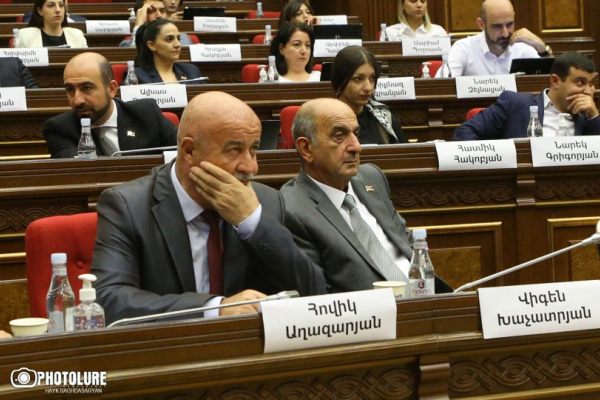
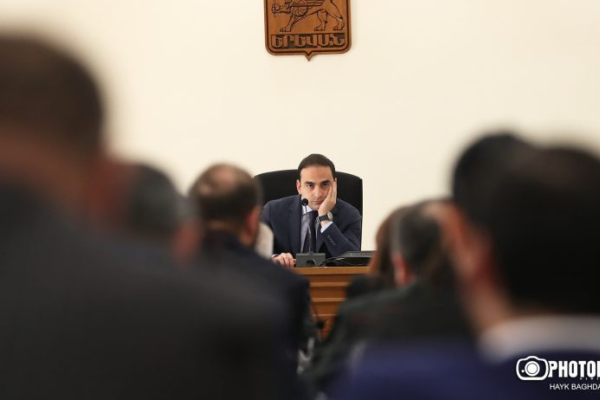
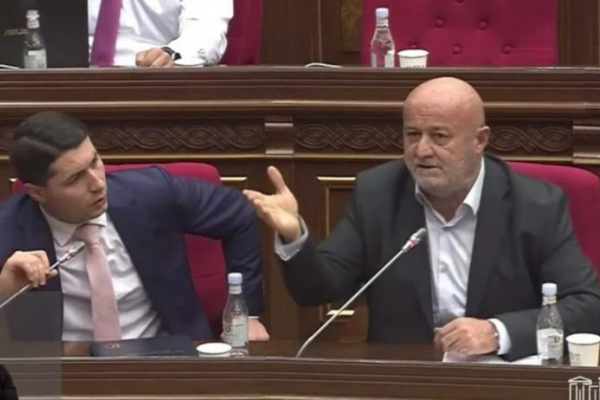
By Tigran Grigoryan and Karena Avedissian Last week, an incident in Armenia’s National Assembly overshadowed proceedings when a heated exchange erupted between Argishti Kyaramyan, head of the Investigative Committee, and Hovik Aghazaryan, a ruling party MP. The altercation began during Kyaramyan’s speech when an individual sitting at the ruling party’s benches heckled him. Kyaramyan responded directly to […]

Read More
Democracy Watch

The Thin Line Between Public Service and Politics: Taron Chakhoyan’s Case

By Tatev Baghdasaryan and Karena Avedissian Recent concerns surrounding Taron Chakhoyan, Deputy Chief of Staff to the Prime Minister, have sparked debate over his compliance with the Armenian Code of Public Service. The issues primarily relate to his social media activity and alleged ties to media outlets affiliated to the ruling party. The position of Deputy […]

Read More
Publications

Why Armenian Anti-Government Movements Fail: The Need for a Viable Opposition in Armenia

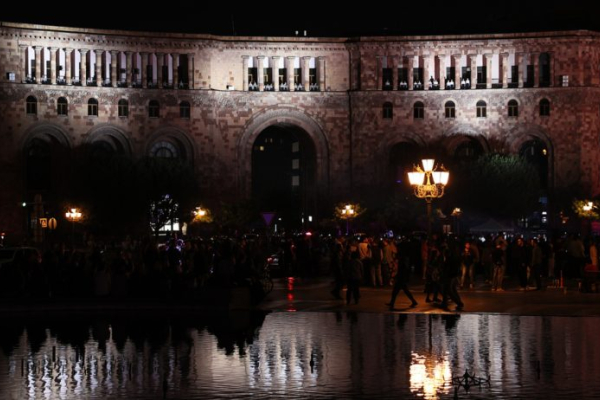
By Tigran Grigoryan This month, Archbishop Bagrat Galstanyan attempted to reinvigorate his Tavush for Homeland movement with a rally in Yerevan’s Republic Square. Galstanyan had launched the movement in April, initially to protest the government’s approach to delimitation with Azerbaijan, and later to demand Prime Minister Pashinyan’s resignation. However, the rally signaled the movement’s decline. It […]

Read More
Publications

Armenia’s Ruling Party Resists Amending Controversial Constitutional Clause

By Tigran Grigoryan and Karena Avedissian On September 19, the Constitutional Reform Council debated and ultimately rejected a proposal by the Union of Informed Citizens (UIC) to remove the constitutional provision that guarantees a stable majority in parliament before the 2026 elections. This provision, a central issue in discussions on electoral reforms, ensures a parliamentary […]

Read More
Publications

Building Empathy Bridges: Lessons from a Bookstore Event in Washington for Armenia’s Polarized Society

By Tigran Grigoryan On a recent work trip to Washington D.C.––my first visit to the United States––I found myself in my hotel room browsing online for interesting places to explore. I discovered Politics and Prose, a well-known bookstore, and decided to check it out. While looking through the shelves, I noticed the staff setting up […]

Read More
Publications

The Cost of Compliance: Armenian Civil Society’s Missed Responsibilities

By Karena Avedissian For the last few years, many Armenians have felt alone — left to contend with increasingly belligerent threats and the consequences of ethnic cleansing in Nagorno-Karabakh. But, paradoxically, the country is receiving more interest from Western capitals than it has in its entire history, with hundreds of millions of dollars being spent […]

Read More
Publications

Hate speech against Karabakh Armenian refugees as a domestic political tool in Armenia

Tigran Grigoryan In Democracy Watch’s previous report my colleague Karena Avedissian and I referred to remarks by Gagik Melkonyan, a ruling party lawmaker, who said, “The people of Karabakh should conduct themselves as guests in Armenia.” Melkonyan’s statement, which has not been condemned by the ruling party, is not just a case of an irresponsible […]

Read More
Democracy Watch

Targeting the opposition: A growing trend at Yerevan’s city hall

By Tigran Grigoryan and Karena Avedissian Local Level Political Suppression An opposition member of Yerevan’s city council Grigor Yeritsyan was relieved of his duties last week, with ruling “Civil Contract” party cited repeated absences from the meetings of the Standing Committee on Legal Affairs of the Council as the reason for his removal. Yeritsyan has […]

Read More
Publications

Armenia needs political competition based on policies, not personalities

By Karena Avedissian In online Armenian spaces, it is not uncommon to see political forces labeling people they disagree with “Turks,” “traitors,” or “Russian agents.” Some degree of polarization is typical in any society, but at a certain point, when it becomes about “us versus them,” it becomes toxic and signals something more troubling — […]

Read More