

By Eduard Arakelyan
The issue of a new uniform for the Armed Forces of Armenia has been under discussion for several years now. A detailed analysis of the protracted process was published in October 2025, optimistically suggesting that the transition to a new uniform would not take place before the fall of 2026 or early 2027.
Now, however, attention is shifting from the timing of the transition to the procedure for testing and introducing the new uniform.
The Armenian Minister of Defense recently stated that a meeting had been held to discuss the implementation of the new military uniform, as well as the progress of field trials. At first glance, these appear to be two parallel processes. However, mentioning them simultaneously raises questions about the sequence for officially adopting the new uniform into service.
On August 12, the Ministry of Defense press service provided some clarification: “The process of introducing the uniforms is determined by the ongoing field trials, as well as the examination of their technical characteristics. Therefore, experimental samples of the new uniform have been distributed to various units of the Armed Forces of the Republic of Armenia, including conscripts and senior officers.”
Of course, certain organizational measures may be carried out in parallel with testing, strictly as part of preparations for the final transition to the new uniform. But in that case, experimental use and official public presentation need to be clearly distinguished from one another in advance.
The Chief of the General Staff, his deputies, and other senior officers are already wearing the new uniform. If these are experimental samples, does that not mean that, should the current version be deemed unsatisfactory, the senior military leadership would have to change into yet another version of the uniform?
Moreover, the question of the status of the experimental sample concerns more than just the uniform itself. If the uniform is considered experimental, can the new chevrons, modified insignia, and other new identification elements placed on it also be considered experimental?
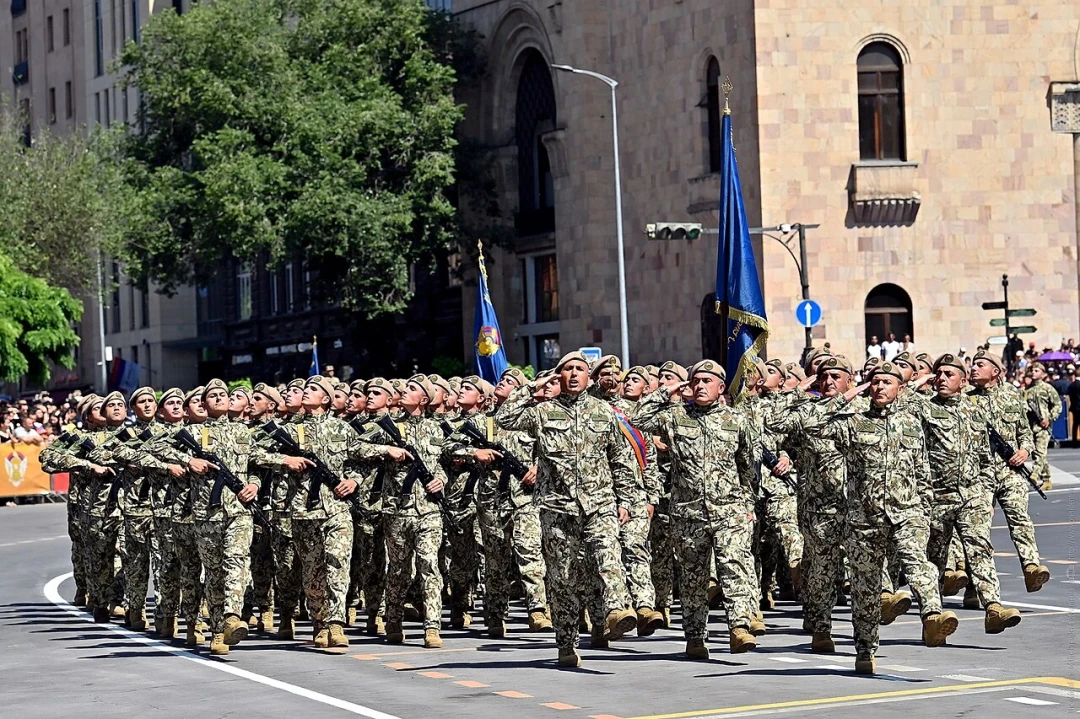
Earlier, army units marched in this uniform during a ceremonial event held for the first time on May 28. Moreover, the event took place less than two weeks before the parliamentary elections on June 7. It naturally appeared to be a presentation of the new uniform for the entire armed forces. At the parade, however, the experimental status of the uniform was not announced.
On May 28, 2026, the new uniform was presented at the state level; on August 12, 2026, that same uniform turns out to be experimental.
A polished presentation and slogans have outpaced full-scale field testing. This situation is fairly typical of countries where the existence of planning—including various doctrines, concepts, and strategies—does not necessarily guarantee consistent implementation in practice.
What a Normal Procedure Should Look Like
When military logistics are properly organized—which is not currently characteristic of the Armenian Armed Forces—the development and adoption of a new field uniform is a multi-stage process. It begins with the development of a concept that takes into account Armenia’s climatic conditions: a sharply continental climate, scorching sunlight and heat in summer, penetrating winds, snow, and severe winter frosts in mountainous areas. Apparently, this basic stage was taken into account from the outset, since Armenia’s climatic requirements are obvious and do not require additional expertise.
This is followed by a stage of field testing, during which a limited batch of uniforms is issued to specific combat units—special forces, reconnaissance teams, or small motorized infantry units operating in different landscape and climatic zones. The uniform is tested for seam durability, fabric resistance to wear when moving over rocks and rough terrain, freedom of movement when shooting, running, and overcoming obstacles, the hygienic properties of the material, its ability to “breathe” under physical strain, and its suitability for different temperature conditions.
The winter uniform must provide adequate heat retention, while the summer uniform must provide sufficient ventilation and prevent overheating. Even torn seams during intensive training or failed Velcro fasteners and zippers in the field can negatively affect the already low morale and psychological condition of personnel.
Only after objective feedback has been collected from soldiers with practical experience should the necessary modifications be made and the uniform approved for implementation. It is at this point that field trials can be considered complete and the process of introducing the uniform throughout the armed forces can begin.
Particular attention during testing should be paid to the camouflage pattern. Camouflage may look acceptable in a ceremonial formation while being excessively conspicuous in areas where combat could potentially take place. Bright, saturated colors can reveal a soldier from a considerable distance. Testing camouflage properties in real terrain—rocky slopes, sun-scorched grass, mountainous and forested mountainous areas, and so on—is one of the key stages. Without it, adopting the uniform into service is likewise premature.
For example, the new French BME camouflage, whose development began in 2016, was approved in 2022, while its introduction into the armed forces began in 2024. The development produced a universal solution for wooded and urban environments, improving soldier concealment, and was preceded by careful work and the proper selection of optimal color schemes.
If a public presentation takes place at a parade before field trials have been completed, then such actions reflect a prioritization of appearances over practicality. The desire to meet a specific deadline—for example, parliamentary elections—can push the command to accelerate the process in pursuit of domestic political objectives.
Parade and Reality
The situation with the new uniform of the Armenian Armed Forces clearly demonstrates the difference between the ceremonial facade and the harsh reality of military service.
Ongoing testing may reveal shortcomings, leaving the Ministry of Defense with a choice. It can either modify the publicly presented design and subsequently replace the batches already produced, which would entail additional costs and reputational damage. Or it can leave the uniform unchanged without addressing the shortcomings, passing the consequences on to the personnel who will have to wear it in their everyday service and, if necessary, in combat conditions.
For the armed forces, the second option is considerably worse than the first. A new uniform must first and foremost meet the requirements of the soldier on the battlefield—and only afterwards look convincing on the parade ground and in conference rooms.
The article was originally published on CivilNet.