

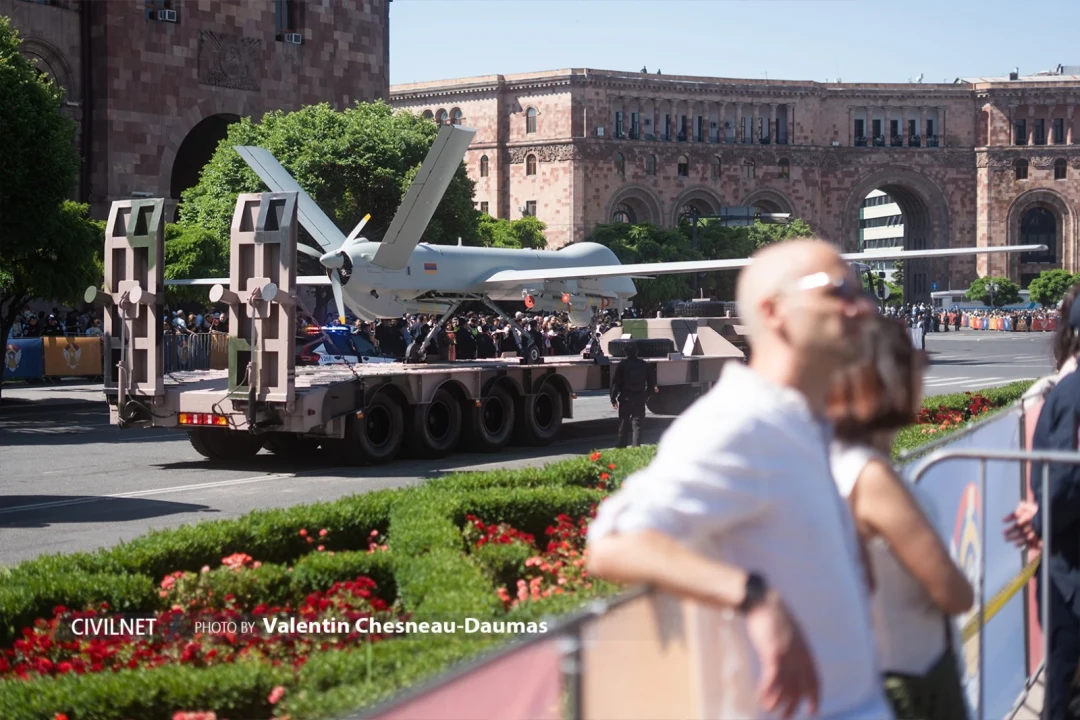
The military parade held in Yerevan on May 28, marking the anniversary of the establishment of the First Republic of Armenia, carries an obvious domestic political significance above all else. Formally, the authorities present the event as a public demonstration of the army’s renewed capabilities and progress in military modernization. However, holding the parade precisely on May 28, just ten days before the vote, clearly ties it to the election campaign.
Military parades and displays of weaponry usually carry specific political and strategic messages. They may be directed both at adversaries and allies: demonstrating new military capabilities, the level of combat potential, readiness for deterrence, and even for war itself.
The current Armenian parade contains very little of this kind of strategic messaging. It does not alter the military-political balance in the region, nor does it signal that Armenia has acquired strategic deterrence capabilities. In essence, the parade’s main — and effectively only — audience is the domestic electorate.
If one sets aside the parade’s role as part of pre-election messaging, it is worth noting that in recent years the Armenian military has begun acquiring a number of weapons systems, including offensive capabilities.
Armenia has nearly tripled its military spending, partially compensated for the losses of 2020, and started diversifying its arms suppliers, moving beyond its previous critical dependence on Russia. Whereas Russia had long been Armenia’s primary arms supplier, after 2022 Yerevan intensified its search for alternative procurement sources, expanding cooperation with several countries in Asia, Europe, and the Middle East.
From this perspective, the parade is interesting because it showcases the material results of this diversification. At the same time, some of the systems purchased from India and France were already known both to specialists and the wider public, and therefore do not fundamentally alter the existing information landscape.
Particular attention should be paid to the presence of several Russian-made weapons systems at the parade, including the Tor M2KM air defense system, the Kornet-M anti-tank missile system — both of which have proven their combat effectiveness in practice — as well as the TOS-1A heavy flamethrower system. This also indirectly suggests that at least part of the Russian weapons deliveries that had been paid for but delayed after 2022 were eventually transferred to Armenia despite the serious problems in defense cooperation between Moscow and Yerevan amid the war in Ukraine and the broader crisis of Russia’s defense industry.
The list of weapons whose delivery had not previously been publicly disclosed is particularly interesting.
Among them are Chinese CH-4B drones (designated “Aghegh” / “Arrow”), GAM-120LR anti-tank missiles (designated “Nizak” / “Spear”), and ASN-301 anti-radiation drones designed to strike radar stations and air defense system components.
Even more intriguing was the presentation of the Iranian AD-08 air defense missile system equipped with an unidentified radar instead of the standard Kashef-99 radar (designated “Karich” / “Scorpion”), as well as, most likely, the Iranian-made Kavosh low-altitude target detection radar — an analogue of the Russian Kasta-2 radar. The parade also prominently featured a number of domestically produced Armenian systems, particularly various unmanned platforms.
Chinese drones and Iranian air defense systems already possess a certain degree of operational and combat experience, allowing for preliminary conclusions about their capabilities and limitations.
Without going into detailed technical specifications, it is worth noting that CH-4B drones are in service in several Middle Eastern and African countries and have been used in conflicts in Iraq and Yemen for both reconnaissance and strike missions.
Iranian air defense systems have also recently been tested under conditions of highly intensive aerial attacks, including episodes involving Israeli and American aircraft, missiles, and drones.
It is worth noting separately that in recent combat the AD-08 reportedly demonstrated effectiveness largely due to its complete stealth characteristics, as the system does not use active radar emissions and is therefore nearly invisible to aircraft warning systems. According to available reports, the system was responsible for downing a significant portion of more than 24 American MQ-9 Reaper heavy drones, as well as Israeli Hermes 900 and Heron drones. In addition, independent sources have linked the AD-08 to the downing of an American F-15E Strike Eagle fighter jet and damage inflicted on an F-35 fifth-generation fighter during recent episodes of aerial confrontation. This is precisely what allows analysts to assess the real operational characteristics of such systems, their resilience under pressure, and their ability to function in the conditions of modern air warfare.
Armenia’s defense industry also showcased a broad range of domestic products, particularly in the unmanned systems segment — from small tactical kamikaze drones to operational-level strike drones, including jet-powered platforms and light bomber drones. In modern conflicts, unmanned systems have already become one of the primary instruments for reconnaissance, strike operations, suppression of enemy air defenses, and the gradual depletion of an opponent’s defensive capabilities.
However, it is still premature to make definitive assessments regarding a significant portion of Armenia’s domestic defense products. Their real effectiveness can only be determined through practical operation in difficult conditions and, above all, possible use in an actual combat environment.
At this stage, Armenian defense companies remain largely tactical players capable of addressing specific tasks. Their future strategic significance will depend on the ability to scale production, reduce production costs, and adapt to the constantly evolving trends of modern warfare, where technologies, drone tactics, and countermeasures evolve extremely rapidly.
The current parade evokes certain parallels with the military parade held a decade ago following the setbacks of the April 2016 war. At the time, the Armenian authorities used the presentation of certain weapons systems as a tool of psychological compensation, domestic political mobilization, and the construction of an image of a combat-ready army ahead of the parliamentary elections of spring 2017. Armenia publicly displayed three classes of missile systems — the Scud-B and Iskander operational-tactical missile systems, as well as the Tochka-U tactical missile complex. In addition, the parade featured Smerch long-range multiple-launch rocket systems, Buk air defense systems, new electronic warfare systems, and several types of reconnaissance drones. The demonstration of these systems was intended to create within society a sense of deterrence and military parity after the psychological shock caused by the April clashes.
But this did not prevent defeat in the 2020 war nor did it decisively influence the course of combat operations. The problem lay not so much in the weapons themselves as in the manner of their employment. A significant portion of Armenian military equipment proved insufficiently protected, poorly integrated into command-and-control systems, and unprepared for the realities of next-generation warfare.
Therefore, the mere display of new weapons systems does not automatically allow one to judge the actual combat effectiveness of the army. Far more important are issues such as personnel training, the resilience of command systems, and the military’s ability to adapt to modern high-technology warfare.
Artillery, drones, and air defense systems are first and foremost instruments of warfare and, in the conditions of modern conflict, are often treated as expendable resources. The possession of new weapons alone guarantees neither military success nor sustainable deterrence. There are other problems extending far beyond weapons procurement. These involve not only organizational issues, the quality of command, discipline, and coordination between different elements of the military, but also the psychological condition of personnel, motivation, training standards, and the overall system’s ability to adapt to the realities of modern warfare.
The authorities are also using the parade as a demonstration of an “army with a new mindset” and as a symbol of military recovery. However, the real strength of the army will become evident only if the new approaches, new equipment, and the military system itself can prove their effectiveness under conditions of real crises and potential combat operations. Ultimately, this is what determines the outcome of wars and the durability of deterrence systems.
In the end, the real Armenian army today is not located on the ceremonial square in central Yerevan. It is primarily stationed in remote garrisons and military bases, as well as on combat positions along the line of contact with Azerbaijan, often reinforced by poorly trained reservists of various ages.
Eduard Arakelyan
RCDS
The article was originally published on CivilNet.