

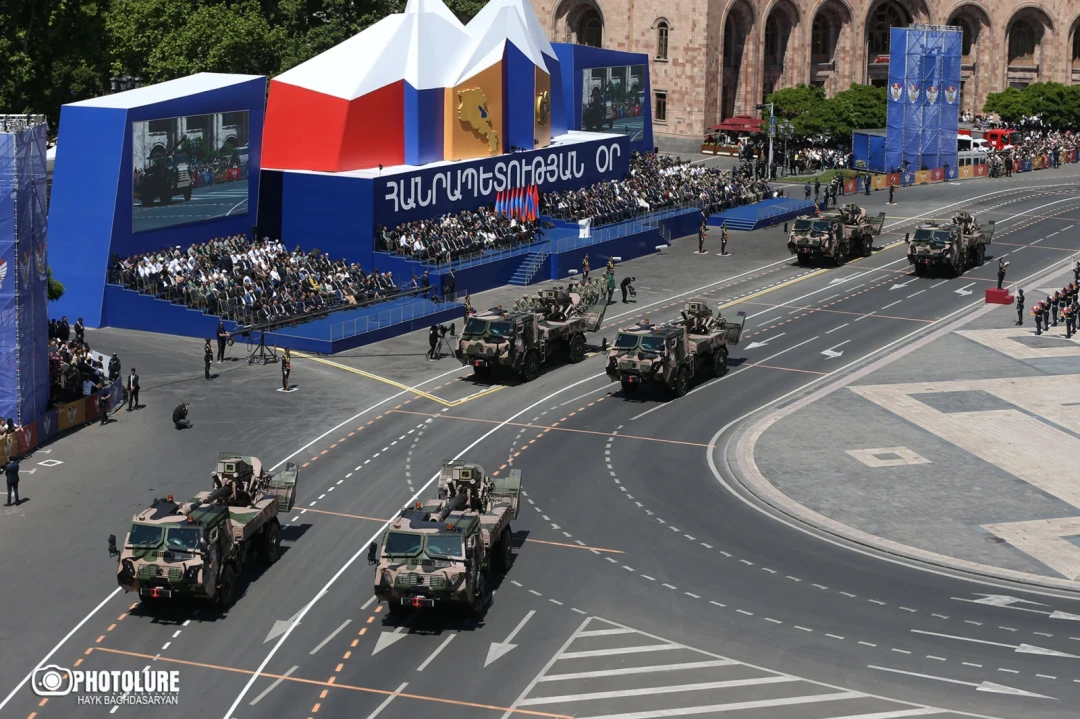
On May 28, a military parade dedicated to Republic Day (the anniversary of the proclamation of Armenia’s First Republic) took place, during which newly acquired weaponry purchased by Armenia from various countries in recent years was put on display. Experts in narrow professional circles were already aware of the acquisition of some of the showcased systems, but the parade also featured new types of weapons whose existence had not previously been publicly reported. The military equipment and weaponry displayed during the parade, as well as their applicability in the Armenian context, deserve separate analysis. However, the main lens through which this parade should be viewed is clearly the pre-election context.
Prior to the May 28 parade, only five major military parades had been organized in the history of Armenia’s Third Republic — in 1996, 1999, 2006, 2011, and 2016 — and they were primarily dedicated to the anniversaries of Armenia’s independence. All of those parades took place on September 21, Armenia’s Independence Day. Never before in Armenian history had a large-scale military parade featuring heavy equipment been organized on May 28, the anniversary of the proclamation of the First Republic.
In this regard, the decision to hold a military parade on May 28 can only be explained by the electoral factor. Ahead of the elections, the Armenian authorities seek to demonstrate to the public, through the display of military hardware, that substantial steps have been taken in recent years to restore the capabilities of the armed forces. It is noteworthy that shortly before the parade, the government also changed the emblem of the army.
The new emblem includes a map of Armenia in the same orange color used by Prime Minister Nikol Pashinyan and the ruling Civil Contract party during their election campaign. Maps with the same design used by Pashinyan during the campaign are considered campaign materials by election experts, while their dissemination or use by representatives of state bodies is viewed as an abuse of administrative resources.
The use of the armed forces for domestic political propaganda did not begin with this parade. For at least the past year, the government had been organizing visits for journalists, experts, and groups of citizens to sections of the Armenian-Azerbaijani border where fortification works had been carried out. At some point, visits also began to be organized to locations where new military equipment had been deployed. The purpose of these visits was also to create an informational environment ahead of the elections suggesting that the government was making serious efforts to strengthen the country’s security.
Yet while during that period one could still cautiously assume that the government intended, through these visits, to report to society on the work carried out, the organization of a large military parade featuring military equipment just ten days before the elections leaves little room for alternative explanations.
The most serious violations recorded during the pre-election phase of the 2026 parliamentary elections have mainly involved either vote-buying or the abuse of administrative resources. In this regard, the military parade can be considered the largest use of administrative resources so far during the pre-election period, and it should be recognized as such by election observation organizations.
However, the abuse of administrative resources and the use of state resources to influence voters are not the most problematic aspects of the parade. This practice could pose a much deeper challenge to Armenia’s democratic development. In consolidated democracies, the political neutrality of the armed forces and other security institutions is one of the fundamental pillars of governance.
This principle is essential both for maintaining democratic stability and for conducting competent, balanced, and responsible foreign and security policy. Political scientists Allan Stam and Dan Reiter, in their book Democracies at War, partly explain through this factor why consolidated democracies tend to be more effective than other political regimes both in wars they initiate and when they are attacked. The main reason is that consolidated democracies are much more cautious and meticulous in calculating the risks of entering wars. Moreover, appointments and promotions in depoliticized armed forces are driven primarily by professionalism and merit rather than political loyalty.
Armenia’s recent history also contains important lessons about the dangers associated with the politicization of the armed forces and the involvement of the military in domestic political processes. In this regard, such an overt use of the armed forces for the ruling party’s electoral campaign can be considered yet another manifestation of visible democratic backsliding in the country.
The propaganda apparatus serving the ruling party will likely attempt to portray the criticism expressed in this article as dissatisfaction with the process of acquiring armaments or as hostility toward the armed forces.
First, it should be noted that such propaganda narratives are almost identical to those previously used by Armenia’s pre-revolutionary authorities, when discussion of the army was effectively taboo and any criticism related to the armed forces was portrayed as a provocation against Armenia’s security. That approach had disastrous consequences.
Moreover, the real expression of hostility toward the army is when an institution whose primary mission is to ensure the country’s security, sovereignty, and the safety of its citizens is transformed into a mere propaganda instrument serving a single political force.
The article was originally published on CivilNet.
Tigran Grigoryan