

By Tigran Grigoryan and Hayk Khanumyan
On May 14, during a meeting in one of Yerevan’s districts, former president and leader of the Armenia Alliance, Robert Kocharyan, criticized Prime Minister Nikol Pashinyan’s “attacks against national identity and the Church” and insulted the ruling party leader, saying: “Now tell me, you hambal (a derogatory Armenian term roughly meaning an uncultured brute or servant), what do you have against that? What compels you, why are your actions hurting an entire people?” This was followed by a campaign of insults directed at Kocharyan by Prime Minister Pashinyan and members of his team. However, the following days demonstrated that political opponents were not the only targets of such rhetoric.
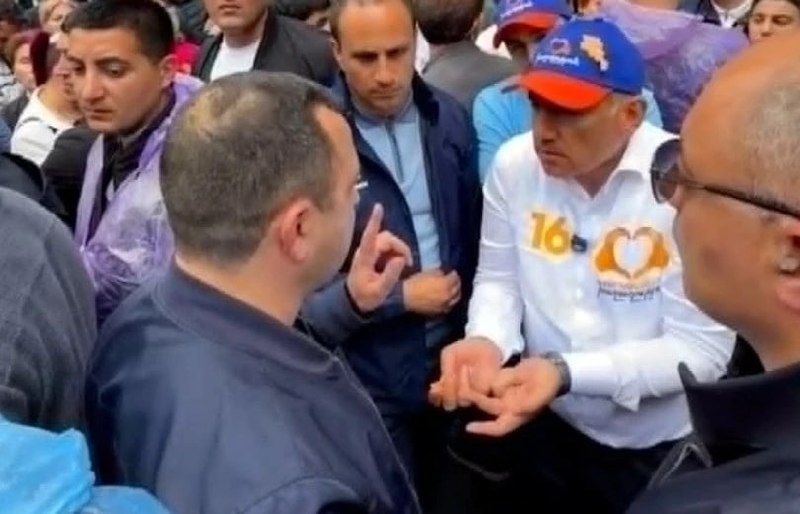
Throughout the campaign period, Nikol Pashinyan has frequently insulted his critics, while also generating hostility toward them. One notable incident occurred on May 18, when the Prime Minister was campaigning in Yerevan’s Arabkir district. A physician, Arpine Soghoyan, approached him and accused him of mismanaging the war, causing thousands of deaths, and losing her homeland. Soghoyan also noted that her brother, a high-ranking military officer, remains missing in action. She further accused Pashinyan of destroying the state.
The criticism enraged Pashinyan. He associated the woman with opposition forces and began shouting at her, claiming that “you tried to make us kneel,” but that he would “but that he would ‘make Rob, Serzh, the Kaluga man, and Gago kneel and destroy them,” referring to former presidents Robert Kocharyan and Serzh Sargsyan, Prosperous Armenia Party leader Gagik Tsarukyan, and Strong Armenia Party leader Samvel Karapetyan.
Responding to the woman’s accusation that he had destroyed the country, Pashinyan replied: “You destroyed it, you destroyed it, you looted through Karabakh.” However, the woman was not forcibly displaced from Nagorno-Karabakh; she had been a resident of that Yerevan neighborhood for decades.
Pashinyan also expressed anger that someone would speak to the Prime Minister in such a manner, saying: “Could you have spoken like that to even the deputy of the deputy of the deputy of a department head in Karabakh? They would have taken you away and killed you, they would have made you into Poghos Poghosyan…” — referring to Poghos Poghosyan, who was beaten to death in 2001 by a bodyguard of then-president Robert Kocharyan. The Prime Minister added that the sister of a missing soldier should be grateful she had not been killed in a restroom.
During the argument, Pashinyan also called Arpine Soghoyan “pitiful,” physically pulled the departing woman toward him, and continued shouting at her.
The Prime Minister, surrounded by bodyguards and using his position of authority, insulting a citizen, violating her physical integrity, grabbing and pulling a departing female citizen, and yelling at her amounted to a demonstrative use of power against a civilian, contradicting the most basic ethical standards expected from a public official.
This incident also represents yet another example of hate speech against refugees being spread at the highest political level, legitimizing stereotypes targeting them. Such behavior by senior state officials and actors associated with them has become systemic during the pre-election period, as documented in two reports published in recent months by the Regional Center for Democracy and Security (the March report and the April report).
The case of Artur Osipyan
The same day, Nikol Pashinyan generated hate speech toward Nagorno-Karabakh Armenians during another campaign meeting in the same district, when Nagorno-Karabakh political activist Artur Osipyan approached him. Osipyan accused Pashinyan of protecting former Nagorno-Karabakh presidents Bako Sahakyan and Arayik Harutyunyan. He stated that he had fought against corruption and abuses in Nagorno-Karabakh, while Pashinyan had defended corrupt officials and had even failed to react to alleged vote-buying by Arayik Harutyunyan during the 2020 elections.
Osipyan also questioned Pashinyan about the Karabakh settlement process, further angering him. Pashinyan responded: “These pseudo-elites of Karabakh come here wagging their fingers. Get lost, who are you anyway? ‘I’m Artur Osipyan’ — you should have died in place of our children. ‘I’m Artur Osipyan,’ you looting animals. Why are you alive? Why are you alive if you’re talking about 5,000 victims, you scumbag, why are you alive?”
Later, Pashinyan released a separate video commenting on a Facebook post Osipyan had made before the encounter. In the post, Osipyan wrote: “If anyone knows where Nikol is, tell me, I’ll grab him and scatter his feathers in the wind.” Responding to the post, Pashinyan escalated his insults, targeting not only Osipyan but also those from Karabakh who survived the war and relocated to Yerevan.
He stated: “Look at this scumbag, these bastards — what are they doing here? Let this bastard explain why he didn’t die, why he didn’t die in a trench. You came to Yerevan to hustle? You and your leadership, your so-called MPs and ministers of Karabakh — sit down and stay in your place. You have nothing to do here until you properly adopt the mentality of Armenian citizens… If we had let scatter his feathers in the wind, only a big piece of his ear would remain, and they’d say we were wrong. Brat, don’t get under our feet, and you brat don’t get under our feet. How long are they going to abuse our modesty? People think we’re fools too.”
Pashinyan’s rhetoric is not only ethically unacceptable and damaging to the authority of state institutions, contributing to deep political polarization, but also specifically targets forcibly displaced persons and fuels public hatred against them. Accusing a survivor of war and forced displacement of remaining alive is extremely troubling. Such rhetoric can create an atmosphere in which war survivors become targets or feel guilty simply for surviving.
It is also noteworthy that Artur Osipyan had been engaged in opposition activism in Nagorno-Karabakh after 2018 and was not part of the ruling elite there.
Shortly after Pashinyan’s public threats and insults toward Osipyan, Armenian police detained the Nagorno-Karabakh activist. The Investigative Committee charged Artur Osipyan under three separate articles: hooliganism, obstructing election campaigning, and public calls for violence. On May 21, he was placed in pre-trial detention for two months.
Several Armenian civil society organizations issued a statement condemning the disproportionate and biased response of Armenian law enforcement bodies to the incident. The statement described Osipyan’s prosecution as politically motivated, unlawful, and aimed at silencing critical speech ahead of the elections.
It is also noteworthy that on the same day, Pashinyan publicly threatened to “make kneel” and “slaughte” his political opponents, yet these statements drew no attention from law enforcement bodies.
The fact that Artur Osipyan was deprived of his liberty within minutes of criticizing the Prime Minister once again demonstrates troubling trends in Armenia’s democratic development. The incident risks creating a climate of fear within society, discouraging people from expressing opinions and publicly criticizing the authorities.
The incident also represents another example of the politicization and instrumentalization of the law enforcement system, in which institutions tasked with upholding legality are transformed into punitive instruments operating according to the whims of those in power.
Pashinyan’s statement that “you have nothing to do here until you properly adopt the mentality of Armenian citizens” is an example of state-level targeting of Nagorno-Karabakh Armenians. Calling on a population that experienced war and forced displacement to “sit down and stay in their place,” while portraying their political and public activism as merely “hustling in Yerevan,” constitutes hate speech at the highest level. Such rhetoric creates the impression that Nagorno-Karabakh Armenians have a secondary status in Armenia and are not entitled to criticize the authorities.
Democracy Watch is a joint initiative of CivilNet and the Regional Center for Democracy and Security.