

The official visit of Armenian Defense Minister Suren Papikyan to Poland began on May 5, 2026. During the visit, the Armenian delegation toured the facilities of the 1st Mechanized Brigade in Warsaw, equipped with Abrams main battle tanks, where they familiarized themselves with the service conditions of the personnel. Papikyan also visited a military university, met with its leadership and Armenian servicemen studying there, and on May 6 took part in the Defence24 security and defense conference.
The key point of the visit was the negotiations at the Polish Ministry of Defense with Minister Władysław Kosiniak-Kamysz. Following these talks, the Polish side stated that Armenia had expressed interest in acquiring the “Polonized” version of the South Korean K2 Black Panther tanks, the production of which will be localized in Poland.
The issue of establishing an Armenian military attaché office in Poland was also discussed, which may indicate that Armenian-Polish defense cooperation is moving into a more practical phase.
The unsuccessful experience of previous Armenian-Polish defense projects: from the unrealized T-72 modernization to the closure of Lubawa Armenia
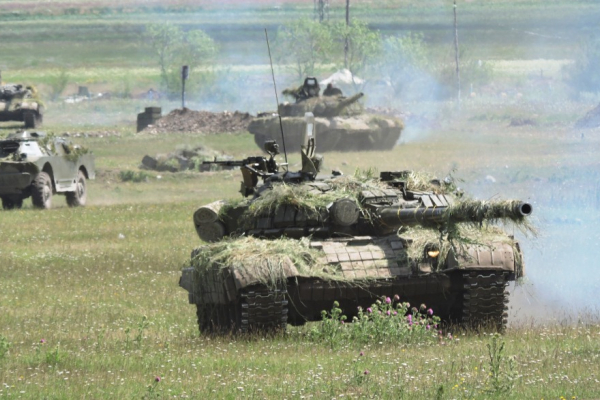
Today, the backbone of Armenia’s armored forces consists of T-72 tanks. These vehicles were produced in the 1970s–1980s and have long been technically outdated. The problem became especially acute during the 2020 war, when Armenian tank units faced the mass use of strike drones and precision-guided missiles. Armenian T-72s entered combat without reactive armor and without effective survivability upgrades for the modern battlefield. Limited night-fighting capabilities also became a serious factor. In effect, Armenian tank units found themselves fighting a new-generation war with equipment whose modernization had been postponed for years.
The issue of modernizing Armenia’s T-72s had already been raised in 2013, specifically in cooperation with Poland. At the time, discussions centered on the possibility of modernization work by the Polish company Bumar Łabędy, upgrading Armenian tanks to the PT-72U standard — a deep modernization package featuring improved protection, a modern fire-control system, thermal imaging equipment, and an upgraded engine. According to available information, the plan involved modernizing 84 Armenian tanks.
However, the project was never implemented. In the autumn of 2016, it became known that Yerevan had chosen to prioritize cooperation with Russia regarding the modernization of its armored fleet, and in the end Armenian tanks received no upgrades at all, while the program was effectively frozen. The 2020 war demonstrated the consequences of this decision: entering a war with equipment not adapted to modern combat conditions.
Notably, the same Polish enterprise, Bumar Łabędy, with which Armenia negotiated in 2013 regarding T-72 modernization, is once again involved today. Production of the Polish version of the K2 tank is taking place at this facility. Thirteen years later, Armenian-Polish contacts in the armored sphere are returning to the same industrial platform, though now in the context of a much more ambitious project.
Armenian-Polish defense cooperation has also seen other problematic episodes. In 2014, the joint Armenian-Polish enterprise “Lubawa Armenia SA” was established, with a controlling stake held by the Polish company Lubawa S.A. and 49% owned by Armenia’s Ministry of Defense. The production facility in Charentsavan manufactured products aimed at the needs of the Armenian army: camouflage nets, decoys, inflatable mock-ups of military equipment, body armor, rapidly deployable tactical and штаб tents, and other specialized products.
However, the project never developed further. In 2019, Lubawa S.A. ceased operations in Armenia.
This became yet another negative example of Armenian-Polish military-technical cooperation.
Re-equipping Armenia’s tank forces: modernization of T-72s or transition to K2?
Current discussions about a possible K2 purchase provoke mixed reactions. On the one hand, this is one of the most modern main battle tanks in the world. The South Korean K2 features a modern fire-control system, advanced electronics, thermal imaging sights, high mobility, and a significantly higher level of protection. Poland is implementing a large-scale localized production program for the K2PL — an adapted version of the tank for the Polish army that will include a number of improvements compared to the base Korean model.
However, the question arises as to the practical feasibility of such a purchase for Armenia. The K2 is an extremely expensive platform both to acquire and to operate. For Armenia, the issue is not only the cost of the vehicles themselves, but also the need to create a new maintenance infrastructure, train crews, establish logistics systems, and ensure supplies of spare parts and ammunition. The K2’s smoothbore gun uses NATO-standard 120mm shells, requiring the purchase of large quantities of ammunition. For example, one such shell may cost two to three times more than the 125mm rounds used by the T-72. Today, Armenia can relatively cheaply procure 125mm ammunition from countries such as India, Iran, and even Russia, whereas amid the global ammunition shortage, European factories are currently overloaded with orders years in advance.
An economically justified option for Armenia could be a deep modernization of the existing T-72 fleet with the installation of thermal imaging systems, communications equipment, reactive armor, upgraded engines, additional armor, and updated fire-control systems — naturally after assessing the current condition and suitability of the tanks for modernization. At the same time, provided that:
a) there are hundreds of millions of dollars available;
b) the purchase of new tanks is considered a priority for army development,
Armenia could plan the acquisition of new tanks and a gradual transition to a new caliber and standards.
In the conditions of modern warfare, characterized by the mass use of inexpensive strike systems — FPV drones, loitering munitions, and anti-tank guided missiles — tanks are becoming increasingly vulnerable. Therefore, without a comprehensive reform of the way tanks are employed, including the integration of reconnaissance systems and unmanned platforms, even the most modern tanks are incapable of fundamentally changing the balance on the battlefield.
Poland as a new element in the diversification of Armenia’s defense ties
Nevertheless, the negotiations with Poland themselves carry important defense significance. Over recent years, Poland has become one of Eastern Europe’s defense hubs and is actively expanding its domestic arms production.
Interestingly, Warsaw is also actively developing cooperation with India: the successful use of Polish Warmate drones (produced by WB Group) in combat against Pakistan led to the signing of three new contracts for their supply and localized assembly in India. In turn, India is considering the construction of a plant in Poland for the production of 155mm artillery shells. Following the outbreak of the war in Ukraine, shortages of 155mm ammunition became one of the key problems facing European armies.
The creation of an Armenian military attaché office in Poland is also an important step in building direct and sustainable ties with the Polish defense industry. Under such conditions, a military attaché performs functions broader than simple diplomatic representation. Through the military attaché apparatus, negotiations on arms procurement and direct contacts between military headquarters and defense enterprises are usually coordinated.
The topic of possible future purchases from Poland — whether K2 tanks or other systems — may become a continuation of Armenia’s process of diversifying its defense ties and searching for new partners. This fits within the policy of the Armenian authorities aimed at reducing dependence on Russia after the events of recent years.
Eduard Arakelyan
RCDS
The original was published on Civilnet.am