

By Eduard Arakelyan
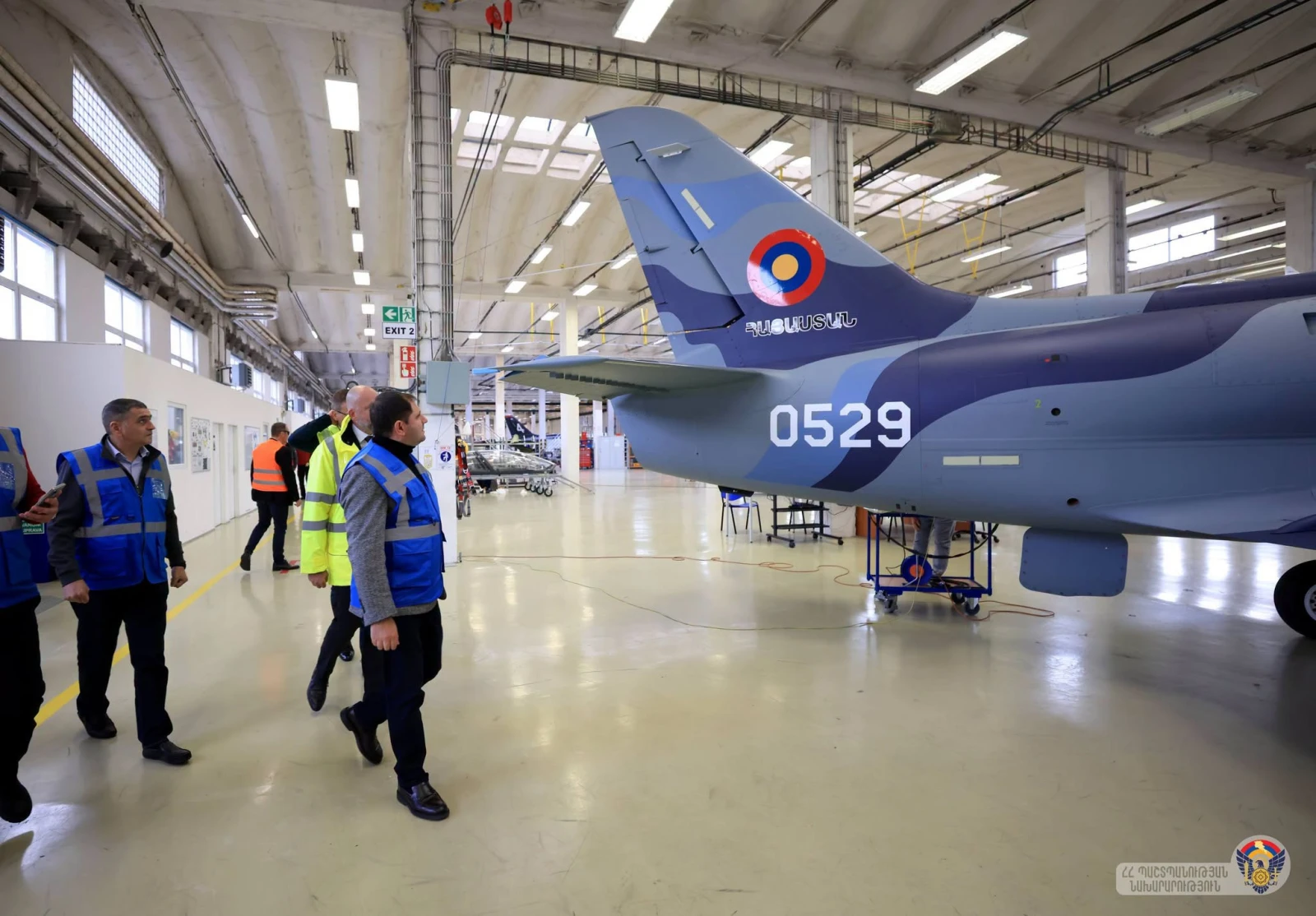
On October 20, Armenian Defense Minister Suren Papikyan arrived in the Czech Republic on an official visit and published a video showing an L-39 Skyfox aircraft in flight, accompanied by the caption: “Soon, these wonders will be soaring in Armenia’s skies.” The minister also posed for a photograph next to an aircraft bearing serial number 0529, which displayed Armenian national insignia on its wings and vertical tail fin, along with the word “Armenia.”
At the airfield of AERO Vodochody, the minister was also shown flights by Skyfox aircraft bearing serial numbers 0527 and 0528. These aircraft displayed Czech flags, but their paint schemes matched the Armenian livery applied to aircraft 0529. The presence of aircraft specifically marked with Armenian insignia indicates that the aircraft are being prepared for delivery to the Armenian Air Force. The timing of their arrival in Armenia, however, has so far been described only as “soon.”
Earlier, a source in the Czech defense industry reported that AERO Vodochody Aerospace was manufacturing four L-39 Skyfox aircraft for Armenia. Specialized media outlets circulated this information in September, although the manufacturer did not disclose the customer or the terms of the deal.
The groundwork for this development had emerged in early September, when Armenian President Vahagn Khachaturyan visited AERO Vodochody during an official trip to the Czech Republic. According to the company’s September 4 announcement, particular attention was given to the L-39 Skyfox, the next-generation jet trainer in the L-39 family. The president was briefed on the production process and inspected the aircraft on the assembly line.
From Albatros to Skyfox
The Armenian Air Force operates Czech-made L-39 Albatros trainer aircraft acquired secondhand in 2004 and 2010–2011. Some were purchased from Ukraine. It is not known how many of these aircraft remain in the Armenian Air Force’s inventory or are currently airworthy and capable of regular flight operations.
The L-39 Albatros has been used to train military pilots. However, the age of these aircraft, their technical condition, and the limited capabilities of their onboard systems have gradually increased the need to modernize Armenia’s trainer fleet.
The Skyfox represents the next generation of the L-39 family. It is equipped with modern digital avionics, multifunction displays, and an integrated virtual training system that allows different tactical scenarios to be simulated during training flights.
The aircraft is designed for long-term service in both training roles and certain operational missions.
According to Defense Mirror, one Skyfox costs less than $10 million. The actual price depends on the aircraft’s configuration and the terms of delivery. The value of the reported contract with Armenia has not been officially disclosed.
The manufacturer primarily presents the Skyfox as a next-generation jet trainer designed for basic and advanced pilot training. Its onboard systems make it possible to simulate various tactical situations and prepare pilots to transition to modern combat aircraft.
Depending on its configuration, the aircraft can be equipped with air-launched weapons, reconnaissance equipment, and additional external stores and systems. These capabilities allow it to be used for limited strike and reconnaissance missions, as well as for engaging certain categories of slow-moving, low-flying aerial targets.
For Armenia, which has a limited fleet of aviation assets, the possibility of using the Skyfox not only for training but also for selected operational missions is an additional consideration. The acquisition could therefore become a practical component of Air Force modernization, although its scale does not yet justify speaking of a significant change in the combat capabilities of Armenian military aviation.
Four aircraft could constitute an initial batch intended to support the transition to a new pilot training system and curriculum. If the Skyfox acquisition is part of a broader restructuring of the Air Force, expanding the fleet in the future would be a logical next step.
Prospects for Countering Unmanned Aerial Vehicles
Of particular interest is the L-39 Skyfox Drone Hunter project, which AERO Vodochody is developing jointly with Belgian company Thales Belgium. The project aims to adapt the aircraft for counter-drone operations using 70 mm FZ275 LGR laser-guided rockets.
The first configuration of the Drone Hunter variant was presented in September at the NATO Days 2026 exhibition. According to expert assessments, the proposed configuration includes an electro-optical targeting pod and guided rockets with a range of up to eight kilometers. The version on display had two rocket launchers, each carrying seven rockets. However, the aircraft’s configuration allows for up to four launchers, for a total of 28 rockets.
The companies intend to continue integrating and testing the rocket armament. For now, this remains a variant under development rather than an operationally ready solution.
This concept is also relevant to Armenia, given the experience of conflicts in which unmanned aerial vehicles have been widely used for reconnaissance, fire correction, and strikes. An aircraft armed with guided rockets could complement ground-based air defense systems in countering certain types of UAVs.
Armenian-Czech Defense Cooperation
The acquisition of the Skyfox fits within Armenia’s policy of diversifying its sources of military equipment and developing ties with European defense industry manufacturers. The Armenian-Czech defense cooperation agreement, which has been in force since 2023, provides an additional foundation for this cooperation.
Papikyan’s post indicates that the Skyfox acquisition has entered the practical implementation stage. Nevertheless, until the terms of the deal are officially disclosed, several questions remain unanswered, including the actual cost, delivery schedule, aircraft configuration, maintenance arrangements, and the provision of technical support by the manufacturer, including specialist training.
The delivery of four Skyfox aircraft points not to a quantitative expansion of Armenian military aviation but to a generational transition in its trainer aircraft platform. The deal’s significance will depend largely on whether it remains an isolated acquisition or becomes the first stage of a broader restructuring of the pilot training system and the Air Force’s composition.
In the latter case, the Skyfox could serve as a bridge between Armenia’s current training aircraft and future combat aircraft, with the four planes constituting the first batch in a wider Air Force modernization program.
The article was originally published on CivilNet.