

By Eduard Arakelyan
In September, Russian President Vladimir Putin unexpectedly declared that Russia was ready to withdraw its military base from Gyumri if the Armenian authorities decided that they did not need it. Armenia, speaking through its prime minister, responded that it would not seek the withdrawal of the base, but would also not object if Moscow made such a decision. The possible closure of the base would change the security architecture of the South Caucasus.
For Yerevan, the question is what practical value Russia’s military presence in the country currently has for national security. For Moscow, the question is what role it will play in maintaining Russia’s presence in the South Caucasus.
A Base from “Another Era”
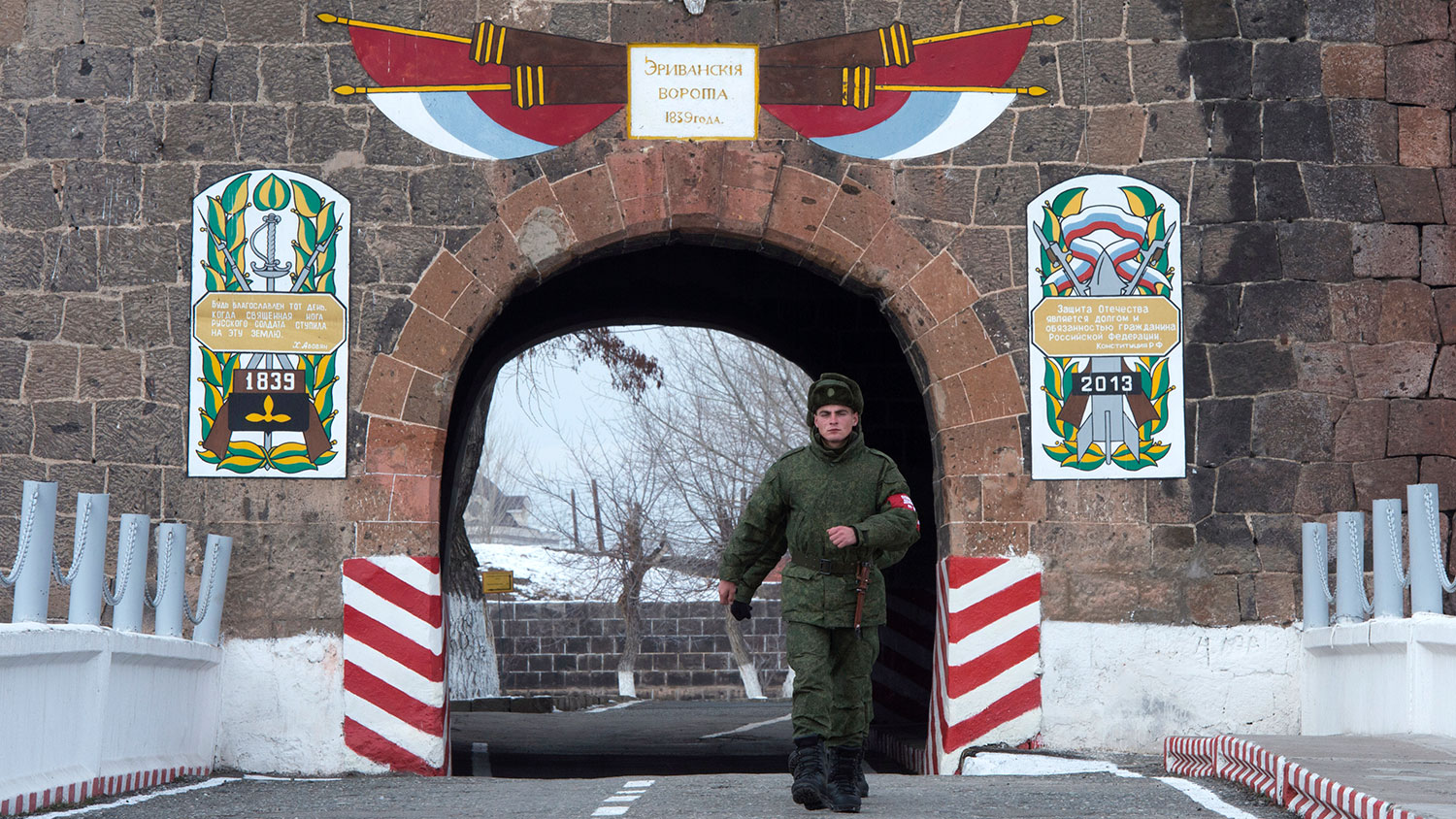
The base in Gyumri was established shortly after the collapse of the Soviet Union, under a regional configuration very different from the one we see today. In 1994, the Soviet 127th Motor Rifle Division stationed in Gyumri was transformed into a Russian military base, and on March 16, 1995, Moscow and Yerevan signed an agreement that legally formalized its presence in Armenia. In 2010, the base’s deployment period was extended until 2044.
This took place under very specific geopolitical conditions. The Armenian-Azerbaijani confrontation was the main source of military threat to Armenia, the border with Turkey was closed, and Russia sought to maintain its military presence on the territory of the former Soviet Union, unwilling to lose its position in the South Caucasus.
From the outset, the base in Gyumri was part of a broader security system. It provided Russia with a military presence in Armenia and, through that presence, with influence over the political and military situation in the region. This architecture was complemented by the Russian air base in Erebuni in the northwestern part of the country, border units of Russia’s Federal Security Service (FSB), and, later, a joint Russian-Armenian grouping of forces and a common air defense system.
After the 2020 Nagorno-Karabakh war, at Yerevan’s request, Russian forces were deployed along the most vulnerable sections of Armenia’s border with Azerbaijan. However, in May 2024, Russia and Armenia agreed to withdraw them. The Russian military presence was also reduced along other sections of the border. In 2024, Russian forces left Zvartnots Airport in Yerevan, the Agarak crossing on the Armenian-Iranian border, and several sections of the Armenian-Turkish border. As a result, Russia’s presence in Armenia began to shrink, and its military and political role is already significantly different from what it was just a few years ago.
How the South Caucasus Has Changed
Over the past three decades, it is not only Armenia that has changed, but the entire South Caucasus. The turning point was the 2020 war. After the fighting ended, approximately 2,000 Russian peacekeepers were deployed to Nagorno-Karabakh. Their task was to maintain the ceasefire, control the Lachin Corridor connecting Armenia with Nagorno-Karabakh, and ensure the security of the Armenian population remaining in the region.
However, this arrangement lasted less than three years. In September 2023, Azerbaijan established full control over Nagorno-Karabakh, after which the Armenian population completely left the region. (This was a forced action driven by fears for security and life; among other things, the European Parliament described Azerbaijan’s attack and the situation in Karabakh as “tantamount to ethnic cleansing,” ed.) The Russian peacekeeping contingent, which under the original plans was supposed to remain in the region until 2025 and provide security for the population, began an early withdrawal and ultimately left the region in June 2024.
These developments had fundamental significance for Armenian-Russian relations.
In September 2022, Azerbaijan launched armed attacks on the internationally recognized territory of Armenia. Following these attacks, Russia did not provide Armenia with military assistance in the form of direct involvement, which Yerevan had expected. Armenian authorities began to assess Russian security mechanisms not on the basis of formal commitments, but according to the extent to which they could actually ensure Armenia’s security.
For decades, Russia’s military presence in Armenia operated in conditions of an unresolved Armenian-Azerbaijani conflict, the absence of diplomatic relations between Yerevan and Ankara, and the persistent possibility of renewed armed confrontation. Today, this configuration is changing.
Armenia and Azerbaijan are negotiating a peace agreement, the delimitation of their border, and the restoration of transport links. At the same time, Yerevan is trying to normalize relations with Turkey and open the land border.
This does not mean that the risks have disappeared entirely. Questions concerning borders, transportation, the military balance, and mutual trust remain unresolved. But the strategic environment is no longer the same as the one in which the 102nd Military Base in Gyumri was established.
“We Will Leave Even Tomorrow”
On September 2, 2026, the Russian president stated that Moscow was ready to withdraw its base “even tomorrow” if Armenia considered it unnecessary. However, Putin said that if Armenian society wanted the Russian military presence to remain, the Russians would “act and cooperate.” The following day, Prime Minister Nikol Pashinyan responded that Armenia had never raised the issue of withdrawing the base in discussions with Russia, but that if Moscow decided to withdraw the base, Yerevan would not protest.
Pashinyan used even stronger language. In his assessment, the events of September 2022 demonstrated that the 102nd Base “does not have vital significance” for Armenia’s security. At the same time, he emphasized that Yerevan did not intend to initiate the withdrawal of the base.
This position is based on a concrete political calculation. Armenia is not demanding the withdrawal of Russian troops from the country, but neither is it assuming an obligation to seek to maintain their presence on Armenian territory. If Moscow were to decide to leave Armenia, Yerevan would not have to bear political responsibility for dismantling Russia’s military presence in the region.
Putin’s words about leaving “even tomorrow” do not literally mean that the withdrawal would take place the next day. In analyzing these issues, it is important to distinguish political decisions from the practical process. The current agreement provides for the base to remain until 2044, and its early closure would require a separate political and legal decision.
It is also worth remembering that the Gyumri base is not simply about soldiers. It involves weapons, equipment, warehouses, infrastructure, property, and logistical systems. A withdrawal would require determining procedures for transferring or dismantling facilities, removing equipment and property, relocating military personnel, and establishing a timetable for the entire process. Therefore, the issue could become the subject of separate negotiations, and the current statements should be viewed as the beginning of a discussion about the status and role of the base.
The Base, Railway, and Gas
The issue of the base overlaps with other problematic questions in Armenian-Russian relations. Yerevan is simultaneously seeking a revision of Russia’s concession to operate Armenia’s railway (Armenia’s railway network is managed by South Caucasus Railway, a company subordinate to Russian Railways, ed.). Pashinyan wants management of the infrastructure to be transferred to a third country acceptable to both Armenia and Russia.
Armenia is seeking to integrate its transportation system into a new regional configuration that envisages restoring connections with Azerbaijan and opening the border with Turkey. Under these conditions, the question of control over railway infrastructure is part of a broader discussion about the future of transportation links across the South Caucasus.
In this case, the railway is not simply a commercial asset, but above all a tool for integrating Armenia into a new transportation and transit system.
At the same time, Pashinyan spoke about the possibility of presenting Russia with financial claims amounting to approximately $2 billion. He did not publicly clarify what the amount consists of, nor did he directly link it to the lease of the 102nd Base. Nevertheless, the timing of these issues allows them to be considered as elements of a broader negotiating framework. This does not mean that the parties are already treating the base as a bargaining chip, but the discussion of the military presence alongside infrastructure and financial issues shows how far Armenian-Russian relations have moved away from the old model of a political and military alliance.
Another potential issue is the price of Russian gas. For Moscow, the energy sector remains an economic instrument of leverage; for Armenia, it is one of the remaining elements of its dependence on Russia. Moscow still has several important instruments of influence over Armenia, including energy supplies and control over a number of infrastructure assets (in the energy sector, ed.). Yerevan has a much narrower range of its own instruments of leverage. Among them, however, is the ability to revise the terms of Russia’s economic and military presence.
In this context, the base in Gyumri can be viewed as a potential negotiating asset. This may not be the result of a deliberate strategy, but uncertainty over the future of the base nevertheless gives Yerevan additional room for maneuver in negotiations on other issues.
If the Russian railway concession is being discussed, the future of the Russian military presence remains an open question in parallel. If changing conditions are affecting energy cooperation, the issue of the base may also form part of the broader context of Russian-Armenian relations.
Maintaining the base allows Moscow to retain its position as a military actor in the Caucasus. If Yerevan no longer considers the Russian presence to be a critically necessary element of its own security, however, it becomes more difficult for Moscow to justify the existence of the base solely on the grounds of defending Armenia. Moscow is then faced with a question: does it want to retain the base as a permanent foothold in the region? The answer could determine what Moscow is prepared to bargain over and what it is not.
For now, there are no grounds to speak of a decision to close the base, but there are grounds to speak of a revision of its role. For Armenia, its significance as a security instrument has become less obvious. From Russia’s perspective, the base may still be important as a military foothold in the South Caucasus. It is precisely this divergence in assessments that will determine the base’s future.
If the parties agree to maintain the base, Moscow will presumably have to define its functions within the new regional architecture and offer Yerevan an appropriate rationale for its continued presence. If, on the other hand, a decision is made to withdraw, that would initiate another lengthy process.
The current situation should therefore be viewed as part of a much broader reassessment of Armenian-Russian relations, ranging from military presence and border infrastructure to railways, energy, and economic assets. The fate of the Gyumri base in this context will be an indicator of the role Russia will retain in the new security system of the South Caucasus.
This article was originally published on the website of the Mieroszewski Centre.