

By Tigran Grigoryan
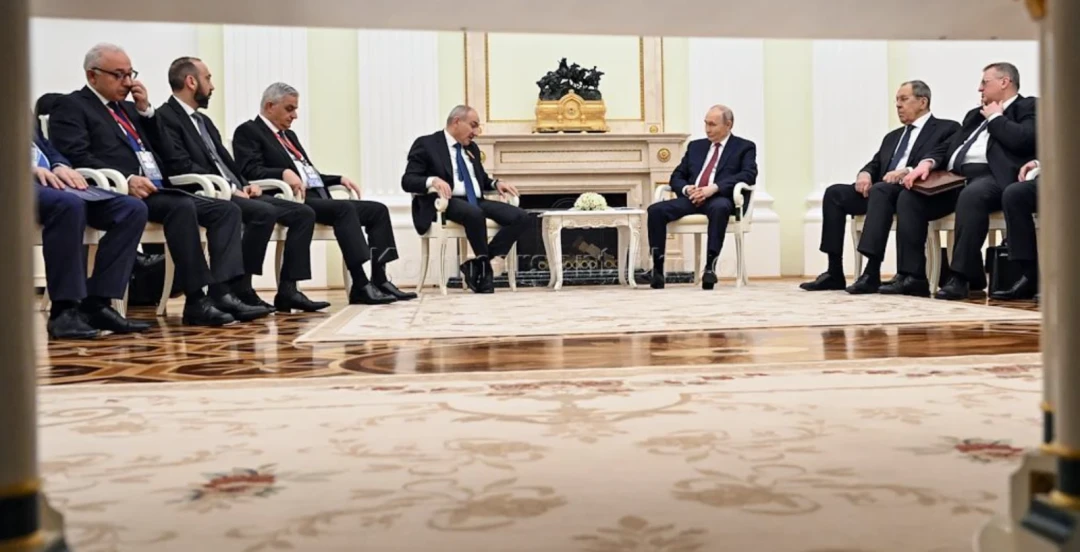
The recent meeting between Armenian Prime Minister Nikol Pashinyan and Russian President Vladimir Putin exposed a widening gap between Yerevan and Moscow over the future of their relationship. Russia continues to view Armenia through the lens of a traditional security alliance, while Yerevan increasingly sees that model as outdated and is seeking to reduce its dependence on Moscow without an abrupt break.On September 1, on the sidelines of the Shanghai Cooperation Organization summit in Bishkek, Armenian Prime Minister Nikol Pashinyan and Russian President Vladimir Putin held their first bilateral meeting since Armenia’s parliamentary elections. The meeting, announced in advance, was followed by public remarks from both leaders and separate comments on the outcome.
The meeting highlighted a deeper problem in Armenia-Russia relations: the two sides increasingly have different understandings of the nature and purpose of their relationship. This gap stems primarily from Armenia’s security experience over the past several years and Russia’s role in addressing those challenges.
Russia’s response to Azerbaijan’s military escalations against Armenia in 2021 and 2022, as well as its conduct during the 2023 ethnic cleansing of Nagorno-Karabakh, has become a central issue in Armenia’s public debate over relations with Moscow. These events have fundamentally weakened the security logic that underpinned the relationship for decades.
For much of the post-Soviet period, Russia occupied a privileged position in Armenia’s security architecture. Armenia’s economic, energy and infrastructural dependence on Russia was partly justified by the expectation that Moscow would provide security and deter Azerbaijani threats. The events of 2021–2023 severely undermined that assumption. Russia did not prevent Azerbaijan’s military operations against Armenia, nor did it prevent the forced displacement of Nagorno-Karabakh’s Armenian population.
At the same time, the conflict with Azerbaijan that had shaped Armenia’s foreign and security policy for decades has largely disappeared. This has created a fundamental disconnect. In Yerevan, there is growing recognition that the previous model of relations no longer corresponds to Armenia’s security environment. This was reflected in Pashinyan’s opening remarks at the meeting with Putin when he noted that the regional context had fundamentally changed and that Armenia-Russia relations needed to be reassessed from a fresh perspective.
In Moscow, however, the old mode of thinking still prevails. In this paradigm, Armenia faces existential threats and cannot counter them without its security alliance with Russia. There appears to be little willingness on the Kremlin’s part to reassess or restructure the essence of the relationship. This perception gap, in turn, creates problems at lower levels, particularly when discussing issues related to Russia’s strategic presence in Armenia.
Putin’s assertion that Armenia’s adoption of a law initiating the process toward EU membership effectively constitutes an application to leave the Eurasian Economic Union was one of the meeting’s most significant points.
Yet reducing the crisis to a dispute over the EU and EAEU misses the broader picture. If European integration were the primary source of the confrontation, it would be difficult to explain why Moscow’s criticism has intensified only recently, more than a year after Armenia adopted the law.
The disagreement is much more structural. Armenia’s railway, the construction of a new nuclear power plant, and Russia’s broader economic and infrastructural presence are all part of the same underlying dispute.
Railway and military presence
The railway dispute illustrates this broader confrontation. At a briefing following his meeting with Pashinyan, Putin appeared to rule out transferring management of Armenia’s railway concession to a third party. At the same time, Moscow has indicated that it currently sees little reason to invest in the railway, as it does not expect a sufficient increase in transportation flows.
This leaves Armenia in a difficult position. The railway requires substantial investment if regional connectivity and trade are to expand, yet Russia appears unwilling to provide that investment while also opposing the transfer of the concession rights to a third party.
For Moscow, the railway is not simply a commercial issue. It is a key part of Russia’s structural presence in Armenia and a way to ensure it is not excluded from regional connectivity projects following the launch of the TRIPP project. That is why the issue has become the main trigger of the current crisis in the relationship and appears to be a red line for Russia.
The exchange over Russia’s military presence in Armenia was even more revealing. Putin said that if Armenia no longer needed the Russian military base, Russia could withdraw immediately. Pashinyan responded that Armenia would have no objection if Russia itself no longer wanted to maintain its presence.
The significance of this exchange goes beyond the future of the base. It reflects fundamentally different perceptions of the security relationship, explained at the beginning of this article.
For decades, Russia’s military presence was closely linked to the assumption that Moscow would provide Armenia with security against regional threats. But the events of 2021–2023 seriously weakened this rationale. Russia failed to prevent Azerbaijani military operations against Armenia and failed to prevent the forced displacement of Nagorno-Karabakh’s Armenian population.
This has forced Armenia to accept Azerbaijani terms in the peace process, conceding to nearly all of its demands. This development, coupled with Russia’s de facto inability to deter Azerbaijan, has contributed to a fundamental shift in thinking in Yerevan regarding Russia’s role in Armenia’s security architecture. The Russian security guarantee is increasingly viewed as neither credible nor significant. In this context, Putin’s statement about the military base was most likely intended as a threat or a form of coercive pressure, reflecting the old way of thinking while failing to account for the fundamental changes that have taken place in Armenia.
Nuclear power and diversification
The future of Armenia’s nuclear power sector is another important point of friction. Russian state nuclear corporation Rosatom remains involved in discussions over a new plant, while the Armenian government has sought to frame the process as an “apolitical” one.
In practice, however, it is difficult to separate the issue from geopolitics. Armenia appears increasingly interested in an American option, with a feasibility study for American small modular reactors completed months ago. Meanwhile, Armenia and the United States are in the final stages of signing and ratifying the 123 Agreement, which would open the door to nuclear cooperation between the two countries.
Yerevan appears to have made a political decision to move forward with a non-Russian option, viewing the process as part of a broader diversification strategy. In that sense, the ongoing talks with Russia over the issue, and the framing of the matter as purely commercial and pragmatic, are largely performative and aimed at placating Moscow’s concerns, at least in the short term. However, the issue remains one of the biggest potential sources of escalation in the ongoing crisis in bilateral relations.
The Bishkek meeting demonstrated that the Armenia-Russia crisis is no longer primarily about individual disputes. The deeper problem is that Yerevan and Moscow increasingly operate with different understandings of what the bilateral relationship should provide.
For Moscow, many traditional foundations of the relationship remain important. For Yerevan, Russia’s failure to deliver the security role it was expected to play, combined with the disappearance of the previous conflict framework in the region, has fundamentally changed the value and logic of that dependence.
Armenia is therefore not necessarily pursuing an abrupt break with Russia. It is pursuing diversification while attempting to manage the risks of reducing its dependence.
The central question is not whether Armenia will choose between Russia and the West tomorrow. It is whether Moscow will accept that the relationship it once had with Armenia is no longer the relationship Yerevan wants to maintain—and how Armenia will fare given the potential costs of this choice.