RISE 2026. Հայաստանի ռազմական արդյունաբերության վիճակը

By Eduard Arakelyan

If we look at the RISE exhibition, which took place on June 3–4 in Yerevan, the most important aspect is not so much the display of individual samples, but the overall picture of the development of Armenia’s military-industrial complex. More than 40 companies from the defense and high-tech sectors participated in the exhibition.

If a few years ago the focus was mainly on individual prototypes, today we can see attempts to build entire production lines. For example, enterprises are now showcasing not only drones, but also components, control systems, communications equipment, ammunition, and elements of fire-control systems.

The exhibition was not limited to advanced weapons and high-tech systems. A number of companies presented elements of individual soldier equipment, including helmets, body armor, tactical gear, load-bearing systems, and other products. Promising examples of Armenian-made small arms were also demonstrated — an automatic rifle built on a bullpup layout, as well as a semi-automatic precision rifle. Both models have a modular design and allow barrel replacement and switching between different types of ammunition, enabling adaptation to various operational tasks.

Such products rarely attract the same level of attention as drones or artillery systems, but they are an important part of the defense industry and help reduce dependence on imports in the area of military equipment supply.

Growth of the artillery sector

One of the most notable developments was the confirmation of production of new artillery munitions in Armenia. In particular, 155 mm NATO-standard shells were shown, along with a range of traditional Soviet-caliber ammunition. This is significant as it indicates an expansion of production capabilities and adaptation to multiple weapons standards.

Particular attention should be given to the development of rocket artillery. Two variants of 120 mm multiple launch rocket systems were presented at the exhibition: a 12-barrel MLRS mounted on an armored vehicle, and a 24-barrel towed launcher. Both systems may currently exist as demonstration models, with no reports of adoption into service. At the same time, the Armenian Armed Forces have already received an 8-barrel 120 mm “Atlant” MLRS mounted on Tata Indian truck chassis, which was previously publicly displayed during a military parade. This may indicate experimentation with balancing mobility, firepower volume, and platform cost.

Additional interest was drawn by the demonstration of domestically produced 120 mm rockets. One company presented such munitions and stated that they are already undergoing testing. Although detailed technical specifications and test results were not disclosed, the very fact of locally produced rocket munitions is significant.

In most cases, building an MLRS is only part of the challenge, while producing rockets requires separate expertise in engines, propellants, stabilization systems, warheads, and serial production organization. Therefore, the demonstration of not only launchers but also ammunition may indicate an attempt to establish a full production cycle in Armenia.

Development of mortar and automated systems

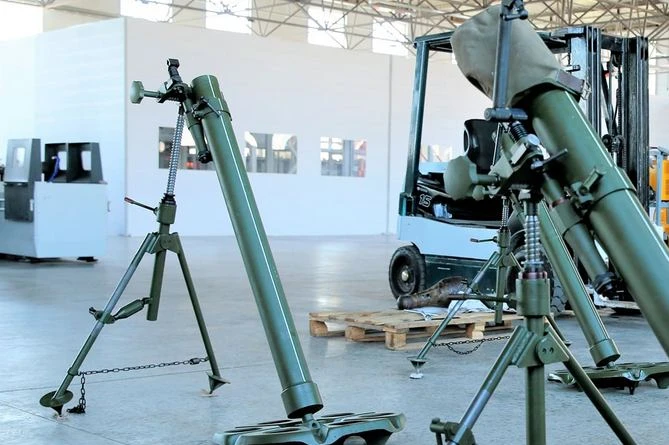
Both mortars of various calibers and automated fire-control solutions were presented at the exhibition. The modular SHANT-22 system demonstrates the intention of Armenian developers to move toward the digitalization of artillery and reduce reaction time on the battlefield. A self-propelled 120 mm mortar system mounted on an armored vehicle was also presented. According to available information, the system is currently undergoing testing. The results will determine its future, including possible design refinements, serial production, and prospects for adoption into service.

In addition to mortar systems, various remotely operated platforms were demonstrated — combat variants designed to carry machine guns, anti-tank weapons, or other armaments, as well as support platforms intended for casualty evacuation, cargo delivery, and other tasks in high-risk environments. These systems also appear to be at different stages of testing and refinement.

Particular attention should be given to MRAP-class armored vehicles. Based on the displayed models, Armenian developers are exploring solutions in the protected troop transport segment. However, the level of localization remains unclear. Most likely, this involves domestic assembly and integration of certain systems, while key components such as engines, transmissions, and other major assemblies are still imported. There is also no information yet on formal adoption into service, suggesting that these vehicles are in early testing stages.

Nevertheless, the very appearance of such vehicles reflects an attempt to enter a complex segment of armored vehicle production requiring integration of multiple technologies.

Strengthening the UAV sector

Based on the exhibits, unmanned systems remain the main direction of development. This now includes not only reconnaissance and strike drones, but also FPV drones, multicopters, control systems, and specialized payloads.

Particularly notable is information about a relatively high level of localization among some Armenian producers, especially in drone assembly, with claims of significant domestic production of components and warheads.

One of the most prominent players in this sector remains the company Davaro, which presented a wide range of developments — from UAVs to various robotic ground platforms. In terms of project scope and diversity, the company effectively holds a dominant position.

Another company specializing in FPV drones and multicopters also deserves attention. In addition to drones themselves, it develops software and various types of warheads, and according to company representatives, has achieved a high degree of localization.

Convergence of the IT sector and the defense industry

Alongside weapons and defense manufacturers, technology companies also presented their solutions. In particular, BooTech demonstrated automated command and control systems for air defense units, artillery, reconnaissance, and special operations forces, aimed at creating a unified digital battlefield management system.

A similar direction is being pursued by Cifora, which presented a C5ISTAR-class platform integrating command, control, communications, intelligence, surveillance, and data processing in a single digital environment. The company has a strategic agreement with UAV and robotics manufacturer Davaro, indicating an effort to build interconnected elements of a unified digital battlefield ecosystem.

This reflects a trend toward integrating Armenia’s IT sector with military development, following a model previously used by Israel and Ukraine.

Formation of export ambitions

The significance of the defense industry goes beyond supplying the armed forces. Military-industrial enterprises create jobs, generate demand for engineering and technical professions, provide tax revenues, and stimulate related industries. With further growth in production and exports, the defense sector could become a standalone branch of the economy.

The Minister of High-Tech Industry of Armenia stated that the defense industry is beginning to move beyond the domestic market and is becoming an export-oriented sector. According to him, in May 2026, products from three unnamed Armenian defense companies were exported to unspecified foreign markets across different regions for tens of millions of dollars.

This is likely one of the key indicators of the exhibition: the defense industry is increasingly seen not only as a tool for equipping the army, but also as an emerging economic sector.

Conclusion

Compared to the period immediately after the 2020 war, Armenia’s defense industry today appears significantly more diversified. The main focus is shifting from importing finished systems to building a domestic production and assembly base. If current trends continue, Armenia may achieve partial self-sufficiency in several categories of weapons within a few years and potentially expand defense exports.

Despite these positive trends, the exhibition also highlighted one key problem — the gap between demonstrating prospective developments and their actual adoption into service.

In modern conflicts, the key factor is not only the ability to create new systems, but also the speed at which they are delivered to troops. Technology and tactics evolve so rapidly that excessively long testing and approval cycles can result in systems becoming outdated before entering serial production. This is especially true for UAVs, electronic warfare systems, communications, and automated command systems, where innovations appear almost continuously. Therefore, the competitiveness of a modern defense industry depends on its ability to rapidly move developments from prototype to production and operational deployment.

A notable example is the “Nairi” radar system developed by the Yerevan Research Institute of Communication Systems. It was first presented more than four years ago at ArmHiTec and has again been showcased at the current exhibition. However, over this period there has been no information about its adoption into service or serial production. This illustrates that even after development and public display, the path to operational use can take years.

A similar situation is observed in the strike UAV segment. Some Davaro developments have been displayed for a long time and continue to evolve. In particular, a strike drone with an X-shaped wing configuration has repeatedly changed its appearance over time and gradually acquired features reminiscent of the Russian “Lancet” loitering munition. However, despite the long development cycle, there is still no public information confirming completion of testing or adoption into service.

These examples suggest that Armenia’s defense industry is gradually building design and engineering capacity, but the transition from prototype to serial production remains one of the most difficult stages. Therefore, the real measure of success is not the number of showcased developments, but the number of systems that complete full testing cycles, enter production, and are delivered to the armed forces.

The article was originally published on CivilNet.