

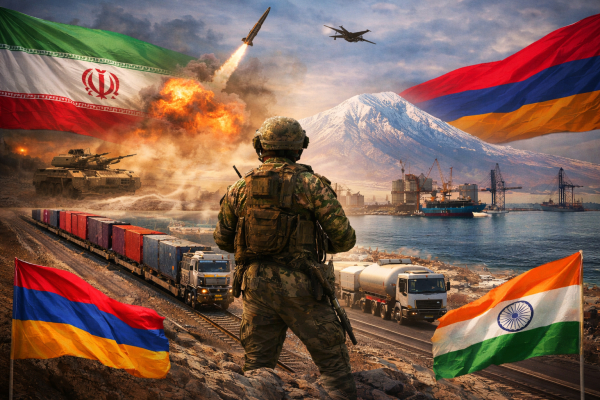
The ongoing war around Iran represents a systemic challenge to the regional balance and carries significant implications for Armenia’s security, economy, and logistical connectivity. Iran plays an important role in Armenia’s external economic relations: key trade routes linking Armenia with the markets of the Persian Gulf and Asia pass through Iranian territory. Iran is also an important component of Armenia’s defense cooperation with India. Iranian ports—most notably Bandar Abbas and Chabahar—provide Armenia with maritime access to Asian markets and serve as key logistical nodes connecting the country with partners in South and East Asia.
In this context, the consequences of the war for Armenia will largely depend on the trajectory of the conflict, its eventual outcome, and the behavior of external actors—particularly India and key regional states.
An important factor shaping the strategic environment is India’s behavior since the beginning of the conflict. Traditionally, New Delhi has attempted to maintain a balance in its relations with different actors in the Middle East. However, recent developments may indicate a gradual shift away from this approach. Indian Prime Minister Narendra Modi visited Israel two days before the beginning of the strikes and announced the elevation of bilateral relations to the level of a special strategic partnership. After hostilities began, he held telephone conversations with the Israeli prime minister and several leaders of Middle Eastern states—including those of the United Arab Emirates, Qatar, Kuwait, Oman, Jordan, Saudi Arabia, and Bahrain—during which he condemned Iranian attacks. No contacts with the Iranian leadership were reported. At the same time, Indian authorities detained several Iranian oil tankers on 8 February, before the beginning of the strikes against Iran.
These developments may indicate a gradual political alignment of India with the anti-Iranian bloc. For Armenia, this trend is particularly significant because a substantial portion of Indian arms supplies to Armenia transits through Iranian territory. The development of the Iranian logistics hub at Chabahar Port involves an investment of approximately $500 million from India, the majority of which has already been invested. A serious deterioration in relations between New Delhi and Tehran could therefore weaken the strategic value of this corridor and create additional risks, including for Armenian-Indian cooperation.
Even if the conflict remains prolonged without a decisive outcome in the near term, Armenia will likely face a range of logistical and political challenges. The South Caucasus may become an area of intensified military and intelligence activity by various states involved in or affected by the conflict. Regional airspace could increasingly be used for the transit of missiles and drones, raising the level of military-political volatility near Armenia’s southern borders. While this would not necessarily imply Armenia’s direct involvement in the war, it would increase uncertainty in the country’s security environment.
Additional instability could arise from worsening relations between Iran and Azerbaijan. Iran’s drone strike on the airport in Nakhchivan triggered a sharp reaction from Baku, which declared heightened combat readiness and effectively closed its border with Iran. This development reduces the immediate significance of the road route through southern Azerbaijan known as the Araz corridor, which had been expected to open in the spring of 2026. According to Azerbaijani Deputy Prime Minister Shahin Mustafayev, the corridor was planned to be launched by the Nowruz holiday (20–21 March). In the context of growing tensions, the strategic importance of alternative routes for Baku—including projects such as TRIPP—may increase significantly.
The logistical consequences of a prolonged conflict would likely include disruptions to transportation corridors through Iran. Cargo delays, rising insurance costs, declining activity in Iranian ports, and increased reliance on routes through Georgia are all possible outcomes. Arms deliveries from India via the Iran–Armenia corridor could also experience delays and rising costs. Nevertheless, as long as the Iranian regime retains control over its territory and core infrastructure, a complete shutdown of these routes would remain unlikely.
Beyond logistical and military-political consequences, the conflict could also generate significant humanitarian and social challenges for Armenia. During the first week of the war, no large-scale population outflow from Iran toward Armenia has been observed. However, depending on how the conflict evolves, different scenarios could lead to the movement of tens of thousands or even hundreds of thousands of Iranian citizens toward Armenia. Among them, a significant share could consist of ethnic Armenians from Iran.
The once sizable Armenian community in Iran has declined significantly over the past decades and is currently estimated at approximately 60,000–80,000 people. Given Armenia’s open land border with Iran, the country could become one of the primary destinations—or at least a key transit route—for people leaving Iran and seeking to move onward to other countries.
Armenia does have some experience in receiving displaced populations from conflict zones. Excluding the forced displacement of the entire population of Nagorno-Karabakh in 2023, the largest comparable experience was the arrival of Syrian Armenians following the outbreak of the Syrian civil war in 2011. According to estimates by the UN High Commissioner for Refugees (UNHCR) and other reliable sources, approximately 22,000 Syrian Armenians relocated to Armenia after 2011, of whom around 14,000 eventually remained in the country. The Armenian government supported them through partial rent subsidies, employment programs, and by mobilizing charitable foundations to cover education, healthcare, and other social needs.
A similar challenge could emerge again if large numbers of Iranian Armenians—or Iranian citizens more broadly—seek refuge in Armenia. Supporting such flows would place additional pressure on Armenia’s state budget and social infrastructure and could contribute to rising unemployment and poverty levels.
Even a relatively moderate influx—on the scale of several tens of thousands of people—could have noticeable economic effects, particularly on the real estate market. Armenia has already experienced similar dynamics following the outbreak of the war in Ukraine in 2022. The sanctions imposed on Russia and the relocation of tens of thousands of Russian citizens to Armenia had a significant impact on the country’s housing market. Beginning in March 2022, real estate prices—especially rents in Yerevan—increased sharply. Although the market later stabilized, average rental prices have remained approximately 30–50 percent higher than their 2022 levels. A comparable effect could occur if a significant number of Iranian citizens relocate to Armenia as a result of the war.
The longer-term implications for Armenia will depend heavily on the outcome of the conflict. Even if the Iranian political system manages to withstand the war and maintain internal stability, the country will nevertheless face enormous economic costs. Destruction of infrastructure, increased sanctions pressure, and the depletion of financial resources could lead to a prolonged period of economic stagnation and reconstruction. Under such circumstances, Iran’s economic capacity would remain constrained for years, slowing the recovery of transport infrastructure and port operations that are important for Armenia’s trade routes.
The continued existence of a functioning Iranian state would preserve an important geopolitical factor that limits the unilateral expansion of Turkish-Azerbaijani influence in the South Caucasus. However, Iran’s postwar economic weakness could significantly slow the recovery of logistical infrastructure and reduce the effectiveness of the transport corridors used by Armenia.
A much more destabilizing scenario for Armenia would emerge if Iran were to suffer a major defeat followed by internal destabilization or fragmentation. In such circumstances, Armenia’s southern border could effectively adjoin a zone of political and military instability. This would significantly increase security risks, including uncontrolled refugee flows, cross-border incidents involving armed groups, and the expansion of illicit arms trafficking.
The logistical consequences would also be severe. A collapse or serious weakening of Iranian state institutions could lead to the effective shutdown of transportation routes across the country and the loss of Armenia’s access to Persian Gulf ports. Armenia would then become almost entirely dependent on transit routes through Georgia, significantly increasing the vulnerability of its external trade.
Defense cooperation with India would also face major obstacles. If Iran were to lose effective control over its territory, both land and air routes used for arms deliveries from India to Armenia could largely disappear. This would significantly complicate Armenia’s ability to receive the weapons it has already paid for.
Overall, the stability of Iran remains of strategic importance for Armenia. Iranian territory hosts some of Armenia’s most important trade and transportation routes and serves as a key logistical corridor connecting Armenia with India and other Asian partners. While a prolonged war will inevitably create serious economic and logistical difficulties, the preservation of a functioning Iranian state would allow the regional system to continue operating, albeit under strain. By contrast, the destabilization of Iran would create far more severe long-term risks for Armenia across the domains of security, logistics, economic stability, migration management, and defense cooperation.
Regional Center for Democracy and Security