

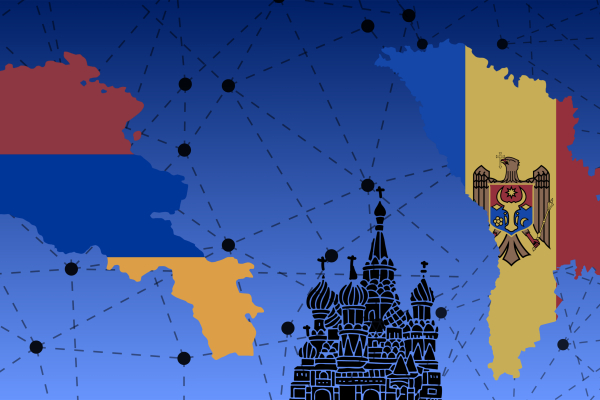
The Regional Center for Democracy and Security has published a new report titled “Comparing Russian Information Influence in Moldova and Armenia: Patterns, Challenges, and Specificities.” The report examines how Russian foreign information manipulation and interference (FIMI) campaigns are constructed, disseminated, and adapted across two distinct post-Soviet environments, with a particular focus on the narratives, actors, tools, and institutional responses that shape information ecosystems in both Armenia and Moldova. It analyses how similar operational logics are deployed in different contexts, and how their effectiveness is conditioned by domestic political structures and geopolitical environments.
Drawing on this comparative framework, the report investigates how influence operations exploit structural vulnerabilities such as EU rapprochement processes, unresolved territorial conflicts, polarised media landscapes, and the role of diasporas. It shows how these factors interact to create conditions in which information manipulation can amplify societal divisions and reframe political debates around sovereignty, identity, and external alignment.
The report concludes that, despite strong similarities in narratives and dissemination infrastructures, including coordinated networks, transnational platforms, and increasingly AI-enabled tools, the impact of these campaigns remains highly context-dependent. It highlights differences in resilience capacities, with Moldova exhibiting a more consolidated institutional and societal response, while Armenia is still in a more recent and evolving phase of counter-FIMI development.
Ultimately, the report argues that Russian information influence should be understood not as a uniform model, but as a flexible and adaptive system whose effects vary according to local political, social, and security conditions, making comparative analysis useful insofar as it accounts for both convergences and structural specificities.
Read the report: